What Is On-Ground Promotion? A Complete Guide for Brands (2026)
In a scroll-heavy, ad-blocked, algorithm-gated digital world, one of the oldest marketing formats is having a genuine resurgence: putting a brand physically in front of people, in real life, and letting them interact with it directly. That's on-ground promotion — and in 2026, it's no longer treated as an old-school add-on to a digital campaign. It's a strategic budget line of its own.
This guide covers what on-ground promotion actually is, the formats it takes, what it costs in India, and how brands should measure whether it's working.
What Is On-Ground Promotion?
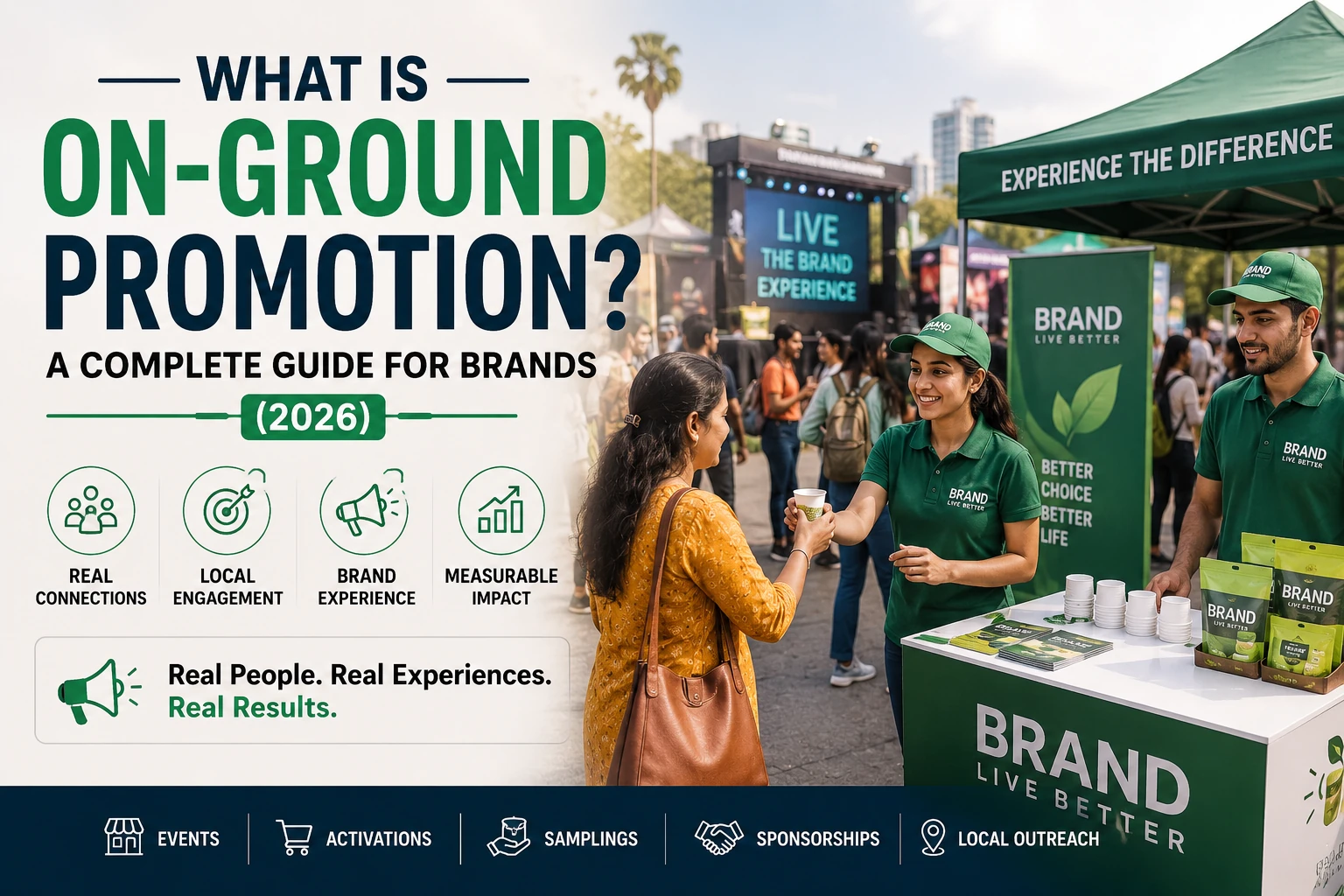
On-ground promotion (also called on-ground marketing, BTL — below-the-line — activation, or experiential marketing) refers to any brand activity that engages consumers in person, in a physical location, rather than through a screen. It covers everything from product sampling in a mall to a fully built brand experience at a festival.
The core idea is participation over observation. A digital ad is something a person sees; an on-ground activation is something a person does — they taste a product, try a demo, enter a contest, or step inside a branded installation. That shift from passive viewing to active participation is what makes on-ground promotion behave so differently from a media impression.
Why On-Ground Promotion Is Growing in 2026
Global spending on experiential marketing is projected to exceed $128 billion in 2026, and in India specifically, a recent EY study found a large majority of consumers now say they prefer experiential brand interactions over traditional advertising — with most surveyed brands planning to increase their experiential budgets this year. A few forces are driving that shift:
- Attention is the scarcest resource in digital marketing. An on-ground experience earns something a 30-second scroll-past ad simply can't: a dedicated, undistracted attention span.
- It fuels digital content, not just physical footfall. A well-designed activation naturally produces shareable moments — creators, attendees, and communities post about it, extending the campaign online long after the event ends. This is why influencer marketing and on-ground marketing increasingly work together rather than as separate budget lines: one builds pre-event buzz, the other gives people something worth posting about.
- It builds first-party data. Registration forms, on-ground contest entries, QR-code interactions, and post-event surveys all create a real, owned data asset — something increasingly valuable as third-party tracking gets harder across digital channels.
- It converts, not just impresses. Nielsen research has found consumers are significantly more likely to buy a product after attending a live brand event, and a large share become repeat customers after an in-person brand experience.
The Main Formats of On-Ground Promotion
Sampling and product demonstrations
Letting people try a product directly — in malls, at events, or door-to-door — remains one of the highest-converting formats for FMCG and food and beverage brands. Footfall-to-trial conversion rates at well-run sampling activations can reach as high as 60–80% for food and beverage categories specifically.
Mall and RWA (Resident Welfare Association) activations
Branded stalls, games, or demos set up in malls or residential societies, aimed at direct, repeated contact with a specific local audience. These remain one of the most common formats for FMCG, electronics, and beauty brands in urban India.
College and corporate campus activations
Brand engagement aimed at students or working professionals — often used by categories like ed-tech, finance, telecom, and youth-focused FMCG brands looking to build early brand association with a specific demographic.
Roadshows
Mobile, multi-city activations that bring a brand experience directly to different markets rather than waiting for audiences to come to a single venue — useful for brands expanding into new geographies or running a coordinated national campaign.
Large-scale experiential activations and immersive installations
The most ambitious end of on-ground marketing — fully built brand worlds, festival activations, or pop-up experiences designed for maximum shareability and press coverage. A recent example: a confectionery brand's collaboration with a popular anime franchise at a major Indian comic convention, which recreated an iconic scene from the show as a walkable installation rather than a standard exhibition stall.
Visual merchandising and point-of-sale (POS) execution
In-store elements — shelf displays, danglers, floor decals, window displays — that influence the moment a shopper is actually standing in front of a product deciding whether to buy it. This is sometimes called the "first moment of truth," and it's one of the most directly sales-linked forms of on-ground execution.
What On-Ground Promotion Costs in India
Costs vary hugely by format and scale, but a few general benchmarks help with planning:
- Cost per on-ground impression in India typically runs in the range of ₹5–15 — often meaningfully lower than comparable traditional out-of-home advertising.
- Overall BTL/on-ground budget allocation typically runs 5–15% of overall marketing spend depending on category, brand maturity, and competitive intensity, with newly launched D2C and FMCG brands often spending 15–25% in their first 24 months specifically to build initial awareness and trial.
- Format complexity drives cost more than city tier. A simple mall sampling activation costs a fraction of a fully built immersive installation — the format and production complexity matter more to the budget than which city it runs in.
How to Measure On-Ground Promotion (It's Not "Unmeasurable" Anymore)
The old knock on experiential marketing was that it couldn't really be measured against digital's clean click-through numbers. That's no longer true — brands running rigorous on-ground programs today track a specific, defined set of metrics:
- Footfall and reach: How many people actually encountered the activation.
- Leads generated: Registrations, sign-ups, or contact information collected on-site.
- Trial-to-conversion rate: For sampling specifically, what share of people who tried the product went on to purchase.
- Social impressions and media pickups: How far the activation traveled once it moved online through attendee and creator content.
- Samples distributed and surveys completed: Direct volume metrics tied to specific activation goals.
The key practical shift: define what success looks like before the activation is designed, not after it wraps. Brands that measure rigorously from the start are the ones that scale their on-ground investment intelligently over time, rather than treating each activation as a one-off spend they can't evaluate.
On-Ground Promotion vs. Traditional Out-of-Home Advertising
It's worth being precise about the difference, since the two get lumped together. Traditional OOH — billboards, hoardings, transit ads — is a one-way message placed in a physical location. On-ground promotion is an interactive experience that invites participation. A billboard can be seen by thousands of people passively; an on-ground activation is experienced directly by a smaller number of people, but with far deeper engagement, recall, and — increasingly — a digital afterlife through the content it generates.
Building an On-Ground Promotion Strategy: Where to Start
- Define the objective before the format. Trial generation, lead capture, brand awareness, and pure PR/shareability all call for different activation types — pick the goal first.
- Match the format to the category. Sampling suits FMCG and food and beverage; immersive installations suit categories built around fandom, lifestyle, or aspiration; campus and RWA activations suit categories targeting a specific demographic directly.
- Plan the digital extension from the start. Brief creators or an influencer marketing partner to be present, and design the activation with a shareable moment built in — don't treat digital amplification as an afterthought.
- Set measurement KPIs before execution. Footfall, leads, conversion rate, and social reach targets should exist before the activation launches, not get reverse-engineered afterward.
- Work with an experienced on-ground execution partner. City-specific vendor networks, venue access, and trained promoter staff are hard to build from scratch — an established on-ground or experiential marketing agency typically has pre-negotiated access across cities that would take months to replicate in-house.
FAQs on On-Ground Promotion
What's the difference between on-ground promotion and experiential marketing? The terms are largely used interchangeably in India — on-ground promotion and BTL activation tend to describe the same category as experiential marketing, with "experiential" sometimes reserved for the larger, more immersive end of the format.
Is on-ground promotion still relevant in a digital-first marketing world? Yes — and increasingly more so. It's one of the few formats that reliably earns focused, undistracted attention, and it fuels digital content rather than competing with it, since attendees and creators post about activations organically.
Which brand categories benefit most from on-ground promotion? FMCG, food and beverage, beauty, and electronics tend to see the strongest direct conversion from sampling and demonstration formats, while lifestyle, entertainment, and youth-focused brands tend to benefit most from large-scale, shareable immersive activations.
How much should a brand budget for on-ground promotion? Industry norms generally fall in the 5–15% of marketing spend range for established brands, with newer D2C and FMCG brands often spending more — up to 25% — in their first two years to build initial trial and awareness.