Is Meme Marketing Legal? Copyright, Fair Use, and What Brands Need to Know in India
This article is for general informational purposes and isn't legal advice. If your brand faces a specific copyright dispute or takedown notice, consult a qualified IP lawyer.
Every meme a brand posts is, technically, built on someone else's copyrighted work — a film still, a TV screenshot, a song lyric, a celebrity photo. That doesn't make meme marketing illegal by default, but it does mean brands are operating inside a genuine legal gray zone every time they post one — and in India specifically, that gray zone is narrower than most marketers assume.
Here's what Indian copyright law actually says about memes, where the real risk sits, and how to build a meme marketing practice that doesn't leave your brand exposed.
The Short Answer: It's Not Automatically Illegal, But It's Not Automatically Safe Either
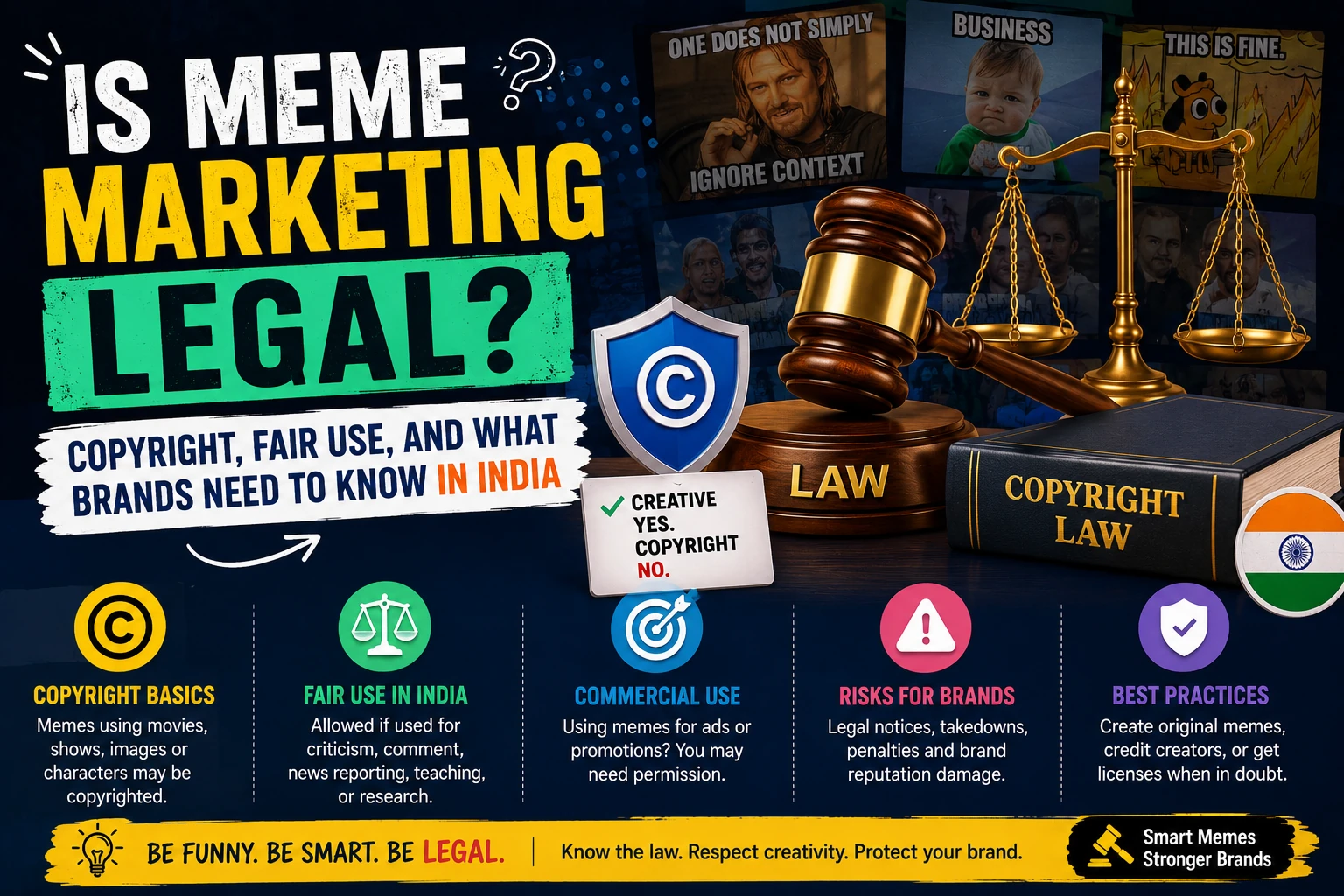
Under the Copyright Act, 1957, using someone else's copyrighted image, film still, or song lyric without permission is, on its face, infringement. What can excuse it is India's "fair dealing" defense under Section 52(1)(a) — a narrower version of the American "fair use" doctrine most marketers are more familiar with. Whether a specific meme qualifies isn't a fixed rule; it depends on a case-by-case legal test, which is exactly why brands can't treat "it's just a meme" as automatic legal cover.
Fair Dealing vs. Fair Use: The Distinction That Actually Matters
American marketers often lean on "fair use" as a broad, flexible defense. India's equivalent — fair dealing — is meaningfully narrower. Indian fair dealing law only recognizes specific, enumerated purposes: private or personal use, criticism or review, reporting of current events, and research or private study. Commercial brand marketing doesn't fall neatly into any of those categories the way a film review or news report does — which is a meaningful legal distinction most meme marketing guides gloss over.
Indian courts still apply a purpose-and-impact analysis, drawing on the same four-factor test used internationally: the purpose and character of the use (commercial or not), the nature of the original copyrighted work, how much of the original was used relative to the whole, and the effect the use has on the market for the original work. The Delhi High Court's ruling in India TV v. Yashraj Films explicitly confirmed Indian courts weigh these same four factors when deciding whether a use is fair.
What this means practically: the more commercial your meme's purpose, the more of the original work it uses, and the more it could plausibly compete with or dilute the value of the original, the weaker your fair dealing defense becomes — regardless of how funny or low-effort the post feels.
What the Legal Tests Actually Look At
1. Purpose and commercial character
A meme posted by an individual for entertainment sits on different legal footing than the same meme posted by a brand's official account as part of a marketing campaign. The commercial intent behind brand-posted memes is precisely what narrows the fair dealing defense.
2. How much of the original was used
Indian legal commentary is fairly consistent on this point: using a single word, phrase, or brief joke from a larger work supports a stronger fair dealing argument than reproducing an entire image, video clip, or song in full. Taking even one full image, screenshot, or short video clip in its entirety — rather than a small, transformed excerpt — is treated as using the "heart" of the work, which weakens the defense considerably.
3. Market impact
If a brand's meme could plausibly reduce demand for, or compete commercially with, the original copyrighted work, that cuts hard against a fair dealing defense. This is less commonly an issue for meme marketing specifically, since a meme rarely substitutes for the original film, show, or song — but it's still part of the legal test courts apply.
4. Transformation and originality
Memes that meaningfully transform the original — adding new commentary, context, or juxtaposition rather than simply reposting it — sit on firmer ground than a straight repost with a caption slapped on top.
Specific Legal Risk Areas for Brand Meme Marketing
- Film and TV stills: Bollywood studios and production houses have a track record of actively protecting their content, including issuing takedowns for content built on movie or show screenshots — even brief, low-resolution ones.
- Music, song lyrics, and audio snippets: Music labels are particularly aggressive about enforcement, and content built on borrowed song hooks or lyrics is one of the most common categories of takedown notices for Indian creators and brands alike.
- Celebrity images and likeness: Beyond copyright, using a recognizable celebrity's image or likeness in a brand meme raises separate personality-rights and publicity-rights concerns — a distinct legal issue from copyright infringement, and one Indian courts have increasingly recognized in celebrity cases.
- Defamation: A meme that could be read as making a false, damaging factual claim about a real person or company carries defamation risk independent of any copyright question entirely.
- Trademark use: Using another brand's logo, mascot, or trademarked material in a meme — even a flattering one — can raise separate trademark concerns beyond copyright.
Does It Matter If the Meme Wasn't Originally Made by the Brand?
Not as much as brands might hope. Resharing a meme created by someone else doesn't necessarily transfer legal responsibility away from the brand — if the underlying meme itself infringes on a copyrighted work, distributing or reposting it commercially can still expose the reposting brand to risk, separate from whoever created it originally.
There's a related, brand-specific risk worth flagging too: if a brand creates an original meme without using anyone else's copyrighted material, and a third party then reposts or profits from that meme without credit or permission, the brand may have its own claim against that third party — copyright protection runs in both directions.
How Brands Can Reduce Legal Risk in Meme Marketing
- Prefer originally created visuals over copyrighted stills. Custom photography, original illustration, or AI-generated imagery sidesteps the underlying copyright question entirely, rather than relying on a fair dealing defense to hold up.
- If using existing content, transform it meaningfully. Add genuine commentary, context, or creative reinterpretation rather than reposting a screenshot with a caption — transformation strengthens any fair dealing argument considerably.
- Avoid using an image, clip, or song in its entirety. Where borrowed content is unavoidable, use the smallest, least "central" portion of the original work that still makes the point.
- Be especially cautious with music and film content. These are the categories with the most aggressive, consistent enforcement history in India — treat them as higher-risk than static image memes by default.
- Credit original creators of user-generated meme formats. This doesn't eliminate legal risk, but it's a meaningful goodwill and ethical practice, and it can matter in how a dispute plays out.
- Avoid identifiable celebrity images without clearance, given the separate personality-rights exposure beyond copyright.
- Build a legal review step into meme approval for higher-risk content. Not every meme needs a lawyer's sign-off, but content built on film stills, music, or celebrity likeness is exactly the category worth a quick compliance check before it goes live on a brand account.
- Respond promptly to takedown notices. Under India's IT Intermediary Guidelines, platforms can be compelled to remove content within a short window once a valid takedown order is issued — having a clear internal process for handling this quickly protects both the brand and its social accounts from platform-level penalties.
A Practical Risk Framework
| Meme content type | Relative legal risk | Notes |
|---|---|---|
| Original brand-created visual/joke | Low | No underlying copyright issue |
| Widely-used, heavily-transformed template with brand's own text | Low–Moderate | Strongest fair dealing position among borrowed formats |
| Full film/TV screenshot with brand caption | Moderate–High | Full reproduction weakens fair dealing defense |
| Song lyric or audio snippet | High | Music labels enforce aggressively and consistently |
| Celebrity image/likeness without permission | High | Separate personality-rights exposure beyond copyright |
FAQs on Meme Marketing Legality in India
Is it illegal for a brand to post a meme using a Bollywood movie still? Not automatically, but it carries real legal risk. Whether it qualifies as fair dealing depends on factors like how much of the original was used, how transformative the meme is, and the commercial purpose behind the post — and film and TV content specifically has a track record of active enforcement in India.
Does crediting the original source protect a brand from copyright claims? No — crediting a source is good practice and can matter for goodwill, but it doesn't itself satisfy the legal fair dealing test or grant permission to use the underlying copyrighted work commercially.
Can a brand get in legal trouble for reposting a meme it didn't create? Yes, potentially. If the underlying meme infringes on someone's copyright, resharing or using it commercially can expose the reposting brand to its own separate legal risk, independent of the original creator.
What's the safest type of meme content for brands to use in India? Originally created visuals and jokes carry the lowest legal risk since there's no underlying copyrighted work involved. Among borrowed formats, widely-used templates that are meaningfully transformed with original brand commentary sit on firmer legal ground than direct film, TV, or music reproductions.