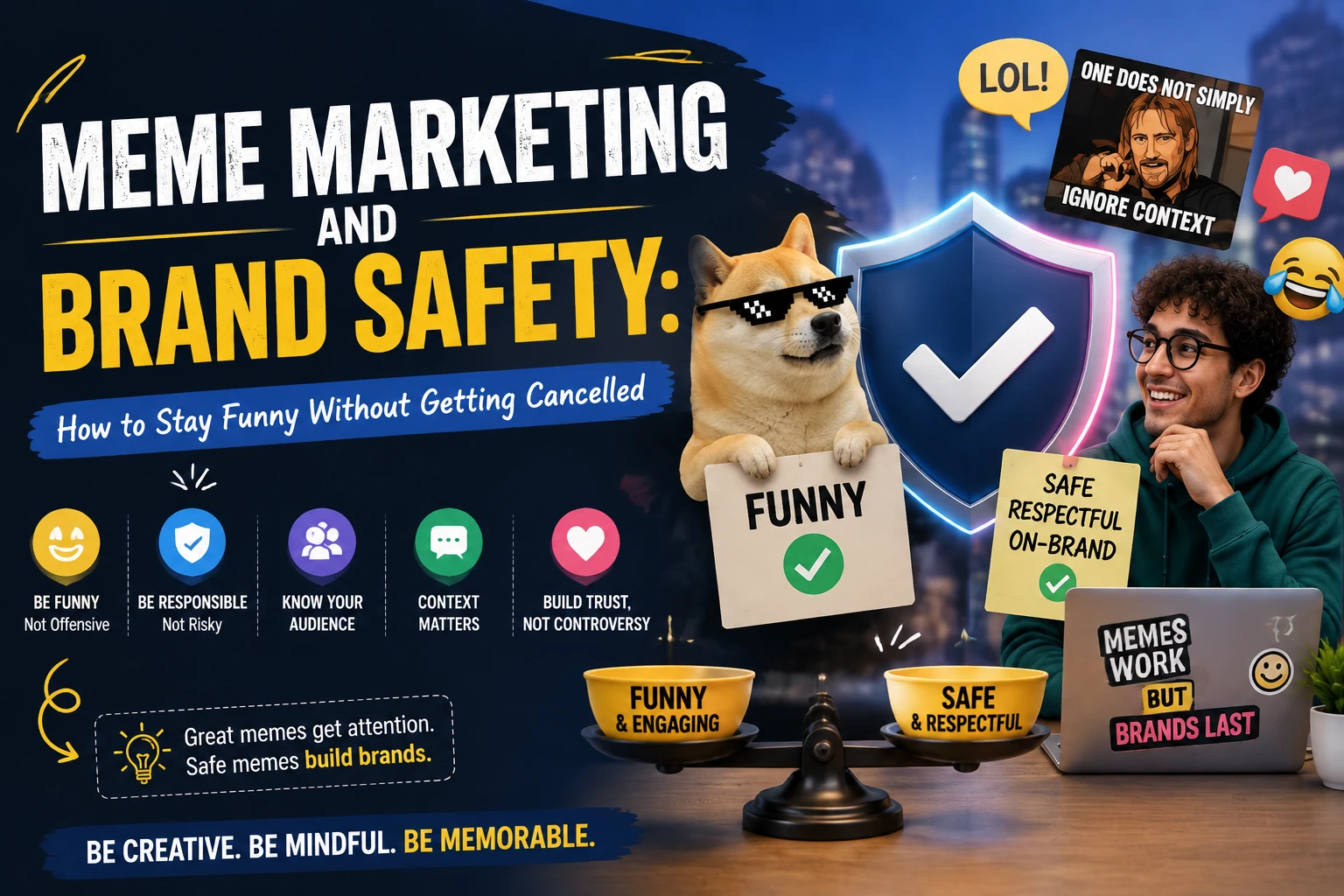
Meme Marketing and Brand Safety: How to Stay Funny Without Getting Cancelled
Meme marketing has one uncomfortable truth built into it: the exact qualities that make a meme work — edge, timing, cultural specificity, a willingness to be a little irreverent — are the same qualities that make it risky. A brand that plays it completely safe rarely produces a meme worth sharing. A brand that plays it too loose eventually produces one that gets it cancelled.
The brands that do this well aren't the ones avoiding risk entirely — they're the ones who've built a system for taking the right risks. Here's how to build that system.
Why Brand Safety Has Become a Bigger Deal in 2026
Brand safety used to mean keeping an ad from appearing next to obviously inappropriate content. In 2026, it covers a much wider surface area — creator partnerships, AI-generated content, meme adjacency to controversial hashtags, and the speed at which a single post can spiral. A majority of digital media experts now expect brand safety concerns to keep growing as content volume — including AI-assisted content — keeps scaling, and social platforms increasingly serve as both the biggest opportunity and the biggest exposure for a brand's reputation.
The stakes are also asymmetric in a specific way: a meme that lands well might get a good engagement bump for a day. A meme that misfires badly can define how a segment of the internet talks about your brand for years.
What Actually Gets Brands "Cancelled"
It's worth being precise here, because "cancelled" gets used loosely. The pattern behind most real brand cancellation incidents isn't one bad joke — it's usually one of these:
- Punching down, not up. Humor that targets a marginalized group, a tragedy, or a vulnerable population reads as cruelty, not wit — regardless of intent.
- Trend-jacking without understanding the trend. Joining a hashtag or format without knowing what it actually means or where it came from — the DiGiorno #WhyIStayed pattern.
- Ignoring cultural or religious sensitivity. Humor that trivializes religious symbols, national sentiment, or deeply held cultural values tends to draw immediate, intense backlash in India specifically.
- A slow or defensive response once backlash starts. The initial post is rarely the whole story — how a brand responds in the following hours often determines whether an incident stays contained or escalates.
- A pattern, not a one-off. A single joke that misses is usually forgivable. A pattern of tone-deaf content signals to an audience that the first incident wasn't a mistake — it's how the brand actually thinks.
Building Brand Safety Into a Meme Marketing Process — Not Bolting It On After
1. Write down what's actually off-limits
Every brand needs an explicit, written list of topics, formats, and tones that are automatically excluded from meme content — tragedies, active crises, religious sensitivities, and anything that could read as mocking a vulnerable group. Vague verbal guidance ("use good judgment") isn't enough under time pressure, which is exactly when meme content gets made.
2. Involve more than just the marketing team in setting guidelines
Legal can flag copyright and defamation risk. PR can spot reputational risk that's legally fine but still damaging. Customer care often has visibility into audience sensitivities marketing doesn't see day-to-day. Building brand safety guidelines with input from all of these functions — not marketing alone — catches blind spots a single team misses.
3. Research before you post, not after
Before jumping on a trending hashtag or format, check what it actually means and where it came from. Hashtags and meme formats can carry baggage that isn't visible on the surface — a phrase that looks harmless can be tied to a controversial community or moment your brand shouldn't be anywhere near.
4. Keep a fast but real approval lane
The tension every meme marketing team faces: speed is the whole point, but zero review is how mistakes happen. The solution isn't removing review — it's making it fast. A single second-person check, even a quick one, catches a meaningful share of avoidable mistakes without killing the reactive speed that makes meme marketing work.
5. Vet creator and influencer partners on an ongoing basis, not just at onboarding
If meme content involves a creator or influencer, their personal content and public history become part of the brand's own risk exposure. A partner's views or past behavior don't need to match the brand's exactly, but a pattern of controversy is a genuine, foreseeable risk — and it needs continuous monitoring, not a one-time check when the partnership starts.
6. Have a real crisis response plan before you need one
Decide in advance who has authority to respond publicly, what the brand's tone is in an apology or clarification, and how fast a response needs to go out once something starts trending negatively. Brands improvising a response in real time during an actual crisis consistently handle it worse than ones working from a plan they built when things were calm.
The Judgment Call Every Meme Needs Before It Posts
Before any borderline meme goes live, run it through a short internal gut-check:
- Who's the target of the joke? If it's a public figure, a competitor, or a general situation, the risk is usually manageable. If it's a marginalized group, a tragedy, or someone in a position of less power than the brand, that's a strong signal to stop.
- Would this still feel fine if it went viral for the wrong reasons? Content that only works if nobody scrutinizes it too closely usually isn't worth the risk.
- Does the team fully understand the reference, or are they guessing at the vibe? Trend-jacking a format nobody on the team fully understands is one of the most common causes of tone-deaf brand content.
- Is this punching up, sideways, or down? Punching up (at power, at the brand itself, at absurd situations) is generally safe. Punching down rarely is.
- If this backfires, do we have thirty minutes to fix it, or would it need to sit overnight? If the honest answer is "we'd need to sleep on how to respond," the content probably needed more review before it posted, not just after.
What to Do If a Meme Actually Backfires
- Respond quickly, but don't panic-delete without acknowledgment. Silently deleting a post without any comment often reads as worse than the original mistake — it looks like the brand is hoping nobody noticed rather than owning it.
- Acknowledge the specific issue, not a vague non-apology. A response that doesn't name what went wrong tends to prolong the backlash rather than resolve it.
- Match the tone to the severity. A genuinely offensive miss needs a sincere, direct apology. A minor tone-deaf joke can sometimes be handled with a lighter, self-aware acknowledgment — reading the actual severity correctly matters as much as responding fast.
- Fix the process, not just the post. A public incident is also useful internal information — treat it as a prompt to review what step in the approval process should have caught it.
Common Brand Safety Mistakes in Meme Marketing
- Treating brand safety as legal's job alone. Reputational risk and legal risk aren't the same thing — plenty of content is legally fine but still damaging, and vice versa.
- No written guidelines, only informal "vibes." Under time pressure, informal guidance doesn't hold up the way a specific, written list of off-limits topics does.
- Skipping research on trending formats. Joining a trend without understanding its origin or associations is one of the most common, most avoidable causes of brand safety incidents.
- One-time creator vetting. A creator partner's risk profile can change after onboarding — ongoing monitoring matters more than a single background check at the start.
- No crisis plan until there's a crisis. Improvised responses during an actual incident consistently perform worse than a plan built calmly in advance.
FAQs on Meme Marketing and Brand Safety
Can a brand do meme marketing safely without losing its edge? Yes — brand safety and humor aren't opposites. The brands that do this well build fast, lightweight review processes and clear guidelines specifically so they can take risks confidently, rather than avoiding risk altogether.
What's the most common cause of a brand's meme content backfiring? Trend-jacking a hashtag or format without fully understanding what it means or where it came from, and humor that punches down at a vulnerable group rather than up at power or absurdity.
Should legal be involved in every meme before it's posted? Not every single post, but higher-risk content — anything touching copyrighted film, music, or celebrity likeness, or anything referencing a sensitive topic — should have a defined review step, even a fast one.
How should a brand respond if a meme gets significant backlash? Respond promptly and specifically rather than silently deleting the post, match the tone of the response to the actual severity of the mistake, and use the incident to review what part of the approval process should have caught it.