How AI Is Changing Influencer Discovery and Campaign Planning
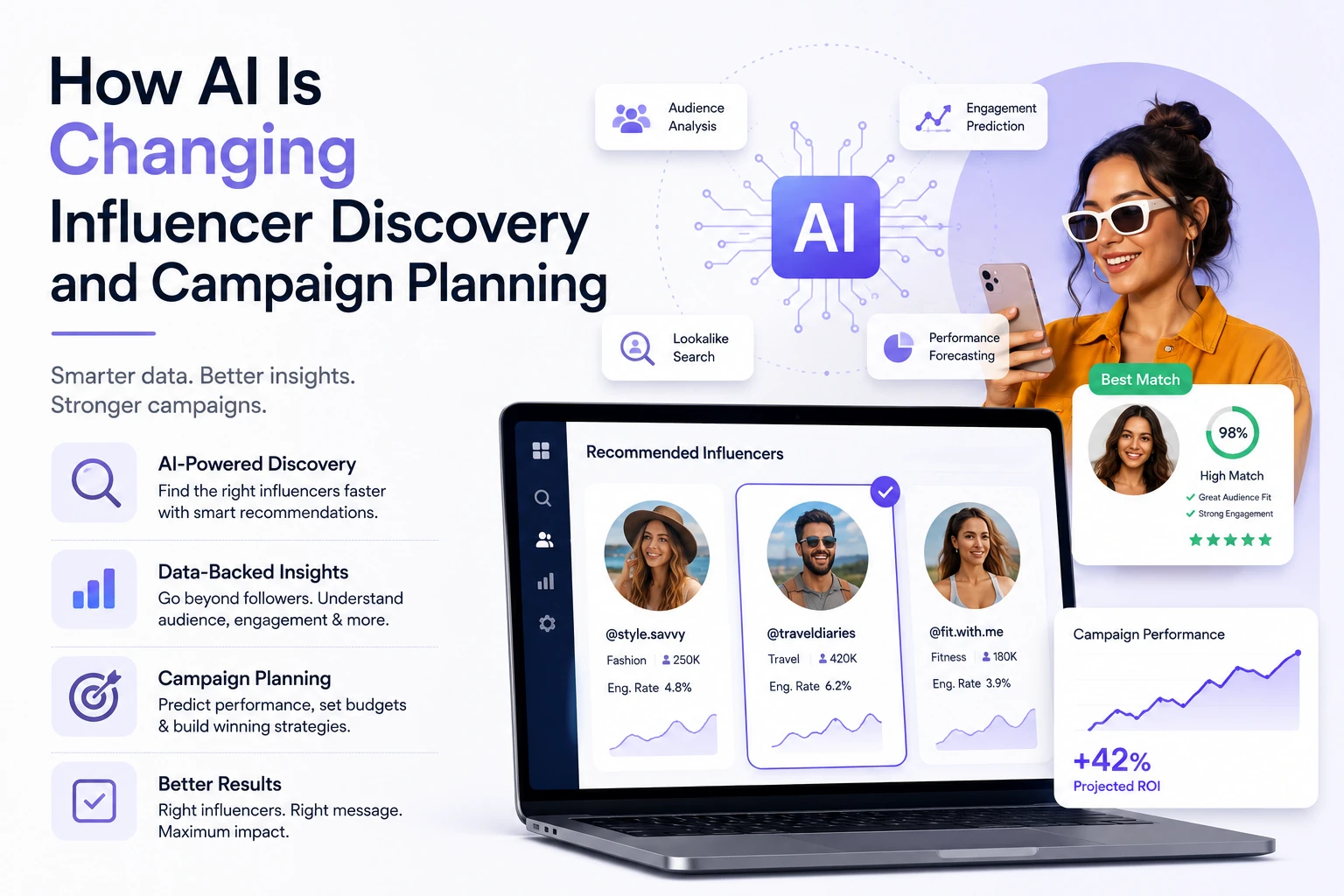
Influencer marketing used to run on a very manual process: scrolling Instagram or YouTube, manually checking follower counts, eyeballing whether engagement looked real, and building a shortlist in a spreadsheet. In 2026, that process is being rebuilt around AI — not to replace the judgment behind influencer marketing, but to compress the research and vetting work that used to eat most of a campaign's planning time.
Here's what's actually changed, what hasn't, and where AI genuinely helps versus where it's still just automation dressed up as intelligence.
Why This Shift Is Happening Now
The influencer marketing industry is projected to reach roughly $32.55 billion globally by the end of 2026 — a scale that's made the old manual-discovery approach a genuine bottleneck. A large share of brands report struggling specifically to find authentic creators amid that growth, and industry estimates suggest AI-powered discovery tools can cut influencer vetting time by more than 75% compared to fully manual research, with brands using automation tools reporting campaigns launching roughly 40% faster than teams managing the process by hand.
That combination — more creators to sort through, more fraud and fake-follower schemes to catch, and more campaigns running simultaneously — is exactly the kind of high-volume pattern-matching problem AI genuinely helps with.
What's Actually Changing: The Real Shifts
1. Discovery is moving from keyword search to natural-language, intent-based search
Instead of searching by follower count or a single niche keyword, brands can increasingly describe what they're actually looking for in plain language — a specific audience profile, content style, or campaign fit — and get a ranked shortlist back. This matters because the old keyword-based search missed creators whose actual content and audience fit didn't match the exact tags they'd used to describe themselves.
2. Fraud and authenticity detection has become far more sophisticated
Fake followers, engagement pods, and bot-inflated accounts have been a persistent problem in influencer marketing for years, and manual spot-checking was never a reliable way to catch them. AI-driven audience analysis tools now flag suspicious growth patterns, engagement authenticity, and audience-quality signals at a scale no human reviewer could match manually — a meaningful upgrade for brands that have been burned by paying macro-influencer rates for an audience that was largely fake.
3. Predictive performance estimates are replacing pure gut-feel
Rather than relying purely on past campaign performance or follower count as a proxy for results, newer tools attempt to estimate a creator's likely performance for a specific brand or campaign type before any money changes hands — based on historical content performance patterns, audience overlap, and engagement quality. This doesn't replace judgment, but it gives brands a data point to sanity-check a gut instinct against before committing budget.
4. Campaign operations — outreach, contracts, and payments — are increasingly automated
Beyond discovery, a growing set of tools now handle the operational load of running influencer campaigns at scale: drafting outreach messages, managing negotiation and contract workflows, and processing payments across dozens or hundreds of creators simultaneously. This is less about creative strategy and more about removing the administrative bottleneck that made scaling past a handful of creator relationships genuinely painful to manage manually.
5. Brand safety vetting now covers more than just follower authenticity
Some AI vetting tools have expanded beyond audience-quality checks into full content and safety analysis — scanning a creator's text, image, video, and audio history for brand-safety risks, which matters particularly for brands in regulated categories like finance or healthcare where a creator's off-brand past content carries real compliance exposure.
What AI Is Genuinely Good At in This Process
- Sorting through volume. Reviewing thousands of potential creators for basic fit and fraud signals is exactly the kind of task AI handles faster and more consistently than manual review.
- Catching authenticity red flags at scale. Engagement-pattern anomalies and fake-follower signals that are hard for a human to spot creator-by-creator become visible fast when analyzed systematically.
- Reducing repetitive administrative work. Drafting initial outreach, tracking contract status, and processing payments across many creators is a natural fit for automation.
- Surfacing creators a manual search would miss. Natural-language, intent-based discovery can find genuinely well-matched creators who wouldn't have shown up in a narrow keyword search.
What AI Still Can't Replace
- Judging genuine creative and cultural fit. Whether a creator's actual tone, humor, and values genuinely match a brand is still a nuanced call that benefits from a human watching real content, not just reading a match score.
- Relationship building. Long-term creator partnerships still depend on trust and genuine rapport — something automation can support logistically but can't substitute for.
- Reading cultural context and timing. Whether a specific creator or content style fits a specific cultural moment is still a judgment call that requires the kind of contextual awareness AI tools aren't fully reliable at yet.
- Final creative and strategic decisions. Every credible source on this shift agrees on the same underlying principle: AI handles research, suggestions, and pattern analysis, while people still make the final calls on strategy, partner selection, and brand narrative.
Categories of AI Tools Now Available to Brands
Rather than recommending specific platforms — the landscape is shifting quickly and the right tool depends heavily on budget and scale — it's more useful to understand the categories now available:
- Discovery and matching platforms that search across large creator databases using natural-language queries rather than rigid keyword filters.
- Audience analytics and fraud-detection tools focused specifically on verifying follower authenticity and engagement quality.
- Predictive performance and scoring tools that estimate likely campaign fit and results before a creator is contacted.
- End-to-end campaign automation suites that combine discovery with outreach, contract management, and payment processing for brands running many creator relationships at once.
- Brand-safety and content vetting tools that scan a creator's broader content history for reputational risk, particularly relevant for regulated industries.
How Brands Should Actually Use These Tools
- Use AI to build the shortlist, not to make the final decision. Let discovery and matching tools surface a wider, better-vetted pool of candidates, but make the final selection based on a genuine human review of the creator's actual content and tone.
- Treat fraud detection as a floor, not a full vetting process. Passing an authenticity check confirms a creator's audience is likely real — it doesn't confirm they're the right creative fit for the brand.
- Don't let automation replace the outreach relationship entirely. AI-drafted outreach can speed up initial contact, but genuine, personal communication still matters for building the kind of long-term creator relationships that outperform one-off transactional deals.
- Keep a human review step for regulated or sensitive categories. Brand-safety content scanning is a useful first pass, but categories with real compliance exposure still warrant a human review before a partnership is finalized.
- Use predictive scoring as a sanity check, not a guarantee. Performance estimates are directionally useful for comparing options, but they're not a substitute for setting real, trackable KPIs once a campaign is live.
FAQs on AI in Influencer Discovery and Campaign Planning
Is AI replacing influencer marketing managers? No — the consistent pattern across the industry is AI handling research, discovery, and administrative automation, while strategic decisions, creative judgment, and relationship building remain human-led.
Can AI tools actually detect fake followers and engagement fraud? Yes, with meaningfully better accuracy and speed than manual review — AI-driven audience analysis tools can flag suspicious growth patterns and engagement authenticity issues across large volumes of creators, which is one of the strongest, most reliable use cases for AI in this space currently.
Are AI influencer marketing tools only useful for large brands running many campaigns? No — smaller brands and startups increasingly use free or lower-cost AI discovery tools specifically because they act as a research accelerator, reducing the time a lean team would otherwise spend manually vetting creators one by one.
What's the biggest risk of relying too heavily on AI for influencer marketing? Treating AI-generated shortlists or scores as final decisions rather than a starting point. The nuance of genuine creative fit, brand voice alignment, and relationship quality still requires human judgment that current AI tools can't fully replicate.