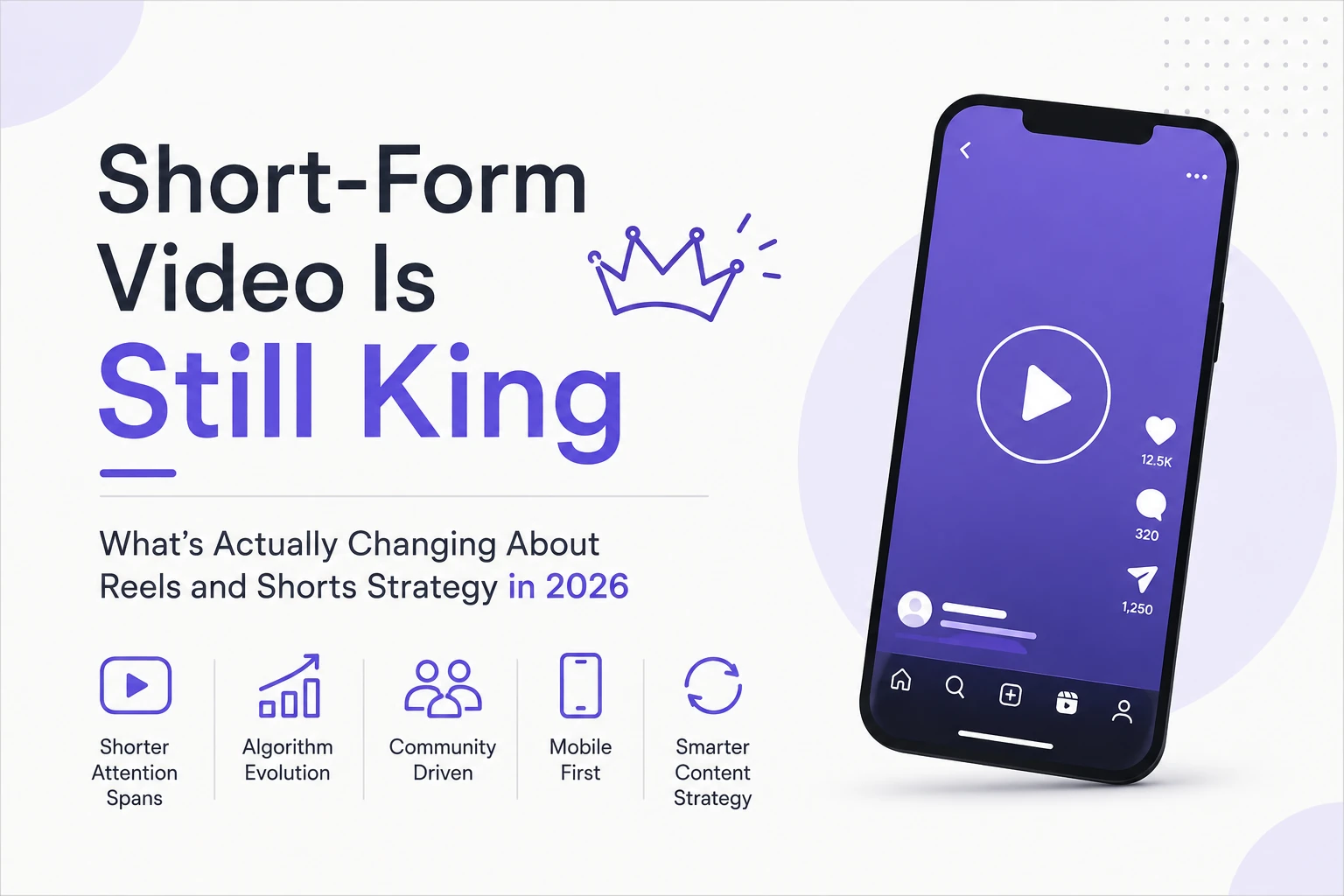
Short-Form Video Is Still King: What's Actually Changing About Reels and Shorts Strategy in 2026
Short-form video hasn't lost its throne in 2026 — but the kingdom has changed shape underneath it. Brands still leaning on the same Reels playbook they built in 2023 are watching reach quietly decline, not because short-form video stopped working, but because the specific signals that earn distribution have shifted meaningfully.
This isn't a "short-form video is dying" post — it isn't. It's a look at what's actually different about how Reels and Shorts perform in 2026, and what brands need to change to keep up.
Short-Form Video Is Still Dominant — But It's Not the Only Format Winning Anymore
The headline data point that gets missed in most "short-form is over" takes: it isn't over, but it's no longer the automatic reach guarantee it was a couple of years ago. A large-scale 2026 industry study analyzing over a million social accounts found Instagram Reels reach dropped roughly 35% year-over-year, alongside a 31% decline in overall Instagram post reach — a signal that the platform's algorithm is spreading distribution across more formats rather than defaulting to short-form video the way it once did.
At the same time, other formats are picking up real ground. Facebook saw a striking reach resurgence — over 50% growth in reach and interactions — while long-form video and community-first platforms are gaining steadier, more reliable engagement in the current environment. TikTok, meanwhile, still leads on raw average reach and interaction volume among short-form platforms, even amid its own engagement softening.
What this means for brands: short-form video is still essential, but it's no longer sufficient on its own. The brands seeing the strongest results in 2026 are diversifying format mix — not abandoning Reels and Shorts, but no longer treating them as the only lever worth pulling.
What's Actually Changing: The Real Shifts Behind 2026 Strategy
1. Longer Reels are being rewarded, not just tolerated
For years, the rule was simple: shorter performs better. That's no longer strictly true. Instagram is now actively recommending longer-form Reels — three-minute tutorials and behind-the-scenes content — in the Explore feed, provided the content genuinely holds attention throughout. This is a real strategic opening for brands with more to communicate than a 15-second hook can carry, but it comes with a catch: length only helps if retention holds. A three-minute Reel that loses viewers at 20 seconds performs worse than a tight 15-second one that holds attention to the end.
2. DM shares have become the single most important ranking signal
On Instagram specifically, sends via direct message now carry the heaviest weight in Reels distribution — more than likes, comments, or even saves. This changes what "good" content actually looks like: the goal isn't just watchability, it's send-ability — content someone feels compelled to privately share with a specific person, not just publicly react to. That's a different creative bar than optimizing purely for a scroll-stopping hook.
3. Captions and on-screen keywords now outrank hashtags for discovery
Hashtags have lost most of their discovery power — Instagram no longer supports following hashtags directly, and keyword-based search through captions and profile text has become the more effective discovery lever. Practically, this means treating a Reel's caption like a genuine SEO asset — specific, keyword-relevant, and descriptive — rather than a stack of loosely related hashtags at the bottom of the post.
4. Cross-posting without adaptation now actively hurts reach
Platforms have gotten meaningfully better at detecting reposted content — visible watermarks from other apps, or video that clearly wasn't shot or edited natively, get demoted rather than just ignored. YouTube specifically now actively demotes content carrying a detected TikTok watermark, and the same logic increasingly applies across Instagram and Facebook. Simply reposting the same file across every platform is no longer a free strategy — it's a active reach penalty in 2026's algorithmic environment.
5. YouTube Shorts is pulling ahead on longevity and intent, even as Reels wins on speed
This is the most important structural difference for brands choosing where to invest. Instagram Reels typically have a genuine discovery window of just 24–72 hours before the algorithm largely stops actively distributing them, and reach is highly dependent on shifting algorithm behavior and trending audio choices in that narrow window. YouTube Shorts, by contrast, get indexed by keywords in titles, descriptions, captions, and even spoken audio — meaning a well-optimized Short from an established channel can keep earning views through both the Shorts feed and YouTube Search well after its initial posting window closes.
There's also a meaningful difference in the audience mindset each platform brings: Reels viewers tend to be in a passive, browsing mode with no specific intent, while YouTube Shorts viewers more often arrive already searching for something specific — information, entertainment, or a solution — a genuinely higher-intent moment for a brand to be present in.
6. AI-driven algorithms are reading intent, not just behavior
2026's ranking systems are increasingly built to understand why someone watched something, not just that they watched it — differentiating between someone who watched because they were genuinely interested versus someone who got stuck mid-scroll and didn't bother swiping away. This subtler signal rewards content that earns real engagement (comments, shares, rewatches) over content that simply avoids being skipped, which is a meaningfully higher bar than pure watch-time optimization used to be.
What Hasn't Changed
- The first three seconds still decide everything. A clear, immediate hook remains the single biggest factor in whether a viewer keeps watching or scrolls past — this fundamental hasn't shifted even as the rest of the strategy has.
- Vertical, native-feeling video still wins. Content shot and edited specifically for the platform it's posted on continues to outperform anything that reads as repurposed or foreign to the format.
- Consistency still beats sporadic bursts. Posting infrequently still causes accounts to lose algorithmic visibility over time — the platforms continue to weight how often an audience has recently engaged with an account, not just how good any single post is.
- Original or well-matched audio still matters, even as its exact role shifts — trending audio still helps established accounts, but forcing an ill-fitting trend can hurt more than help, especially for smaller or newer accounts.
A Practical 2026 Short-Form Video Checklist
- Stop assuming shorter always wins. Test longer, more substantial Reels for content that genuinely needs the space — tutorials, behind-the-scenes, or storytelling formats — but only where retention can actually hold.
- Design for the send, not just the watch. Ask whether a piece of content gives someone a specific reason to DM it to a friend, not just watch it themselves.
- Treat captions as an SEO asset. Write specific, keyword-relevant captions and on-screen text instead of leaning on a hashtag stack for discovery.
- Edit natively for each platform before cross-posting. At minimum, remove other platforms' watermarks and adjust framing and pacing — a single unedited cross-post increasingly costs more reach than it saves in production time.
- Split investment between Reels and Shorts deliberately. Use Reels for fast, trend-responsive, high-frequency content, and YouTube Shorts for more evergreen, higher-intent, search-friendly content that can keep earning views long after the post date.
- Diversify beyond short-form entirely. With Reels reach softening industry-wide, treat carousels, longer-form video, and even a renewed look at Facebook as part of a genuinely multi-format 2026 strategy — not backup options.
FAQs on Short-Form Video Strategy in 2026
Is short-form video still worth investing in for brands in 2026? Yes — it remains one of the highest-engagement formats available. What's changed is that it's no longer the only format worth prioritizing, and the specific tactics that earn reach within short-form have shifted meaningfully.
Why has Instagram Reels reach declined in 2026? Industry data points to Instagram's algorithm spreading distribution across a wider mix of formats — carousels, longer-form Reels, Stories — rather than defaulting to short-form video reach the way it did in previous years, alongside general algorithmic overcrowding as short-form content volume across the industry keeps growing.
Should brands prioritize Instagram Reels or YouTube Shorts? They serve different purposes. Reels are better suited to fast, trend-responsive content that peaks quickly and fades, while YouTube Shorts are better suited to evergreen, search-friendly content that can keep earning views well past its initial posting window.
Does posting the same video across every platform still work in 2026? Increasingly, no. Platforms have gotten better at detecting reposted, unedited cross-platform content — including visible watermarks — and actively demote it rather than simply ignoring it. Native editing per platform is now a meaningful ranking factor, not just a nice-to-have.