UGC Marketing: What It Is and Why Brands Are Investing in It (2026)
Scroll through any Instagram Reel or TikTok "For You" page in 2026 and you'll notice something: the ads that stop your thumb rarely look like ads. They look like a friend unboxing a product, a customer reviewing a serum on camera, or a Reddit thread comparing two brands. That's not an accident — it's UGC marketing, and it has quietly become one of the highest-ROI strategies in a brand's playbook.
If you're a marketer, founder, or brand manager trying to figure out whether UGC deserves a bigger slice of your 2026 budget, this guide breaks down exactly what UGC marketing is, why it works, and how to build a strategy that actually moves revenue — not just likes.
What Is UGC Marketing?
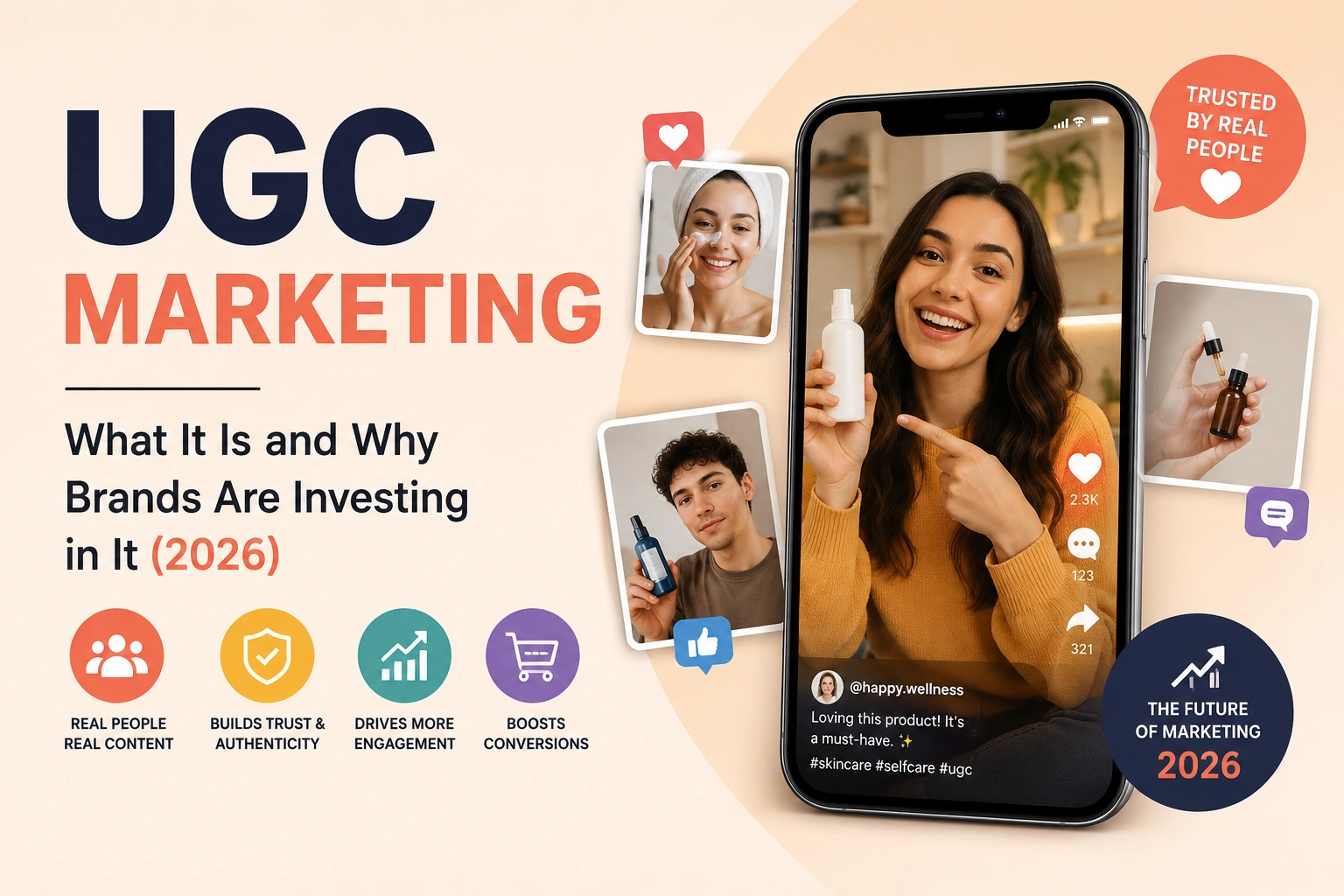
UGC marketing (user-generated content marketing) is the practice of sourcing, creating, and distributing content made by real customers, fans, or creators — rather than the brand itself — to promote a product or service. This includes:
- Customer reviews and testimonials
- Unboxing and "get ready with me" videos
- Product demos filmed by real users
- Before-and-after content
- Social posts, Reddit threads, and comments that organically mention a brand
- Creator-shot content that looks organic but is briefed and paid for by the brand
The defining trait of UGC is authenticity. It's built to feel candid and unscripted, even when it's part of a structured campaign — which is exactly why it outperforms polished, studio-shot brand content across almost every platform.
Why UGC Marketing Works: The Numbers Behind the Trend
UGC isn't a fad — it's a measurable shift in how consumers make buying decisions. A few data points explain why brands are pouring budget into it heading into 2026:
- Trust: The vast majority of consumers say they trust peer recommendations over branded messaging, and consumers consistently report trusting brands more when those brands visibly feature real customer content.
- Engagement: UGC regularly drives multiples higher engagement than brand-produced posts across Instagram, TikTok, and YouTube.
- Conversions: Product pages and ads that incorporate UGC see significantly higher conversion rates than those relying solely on studio content, and UGC-led ads tend to bring down cost-per-click meaningfully compared to brand-only creative.
- Cost efficiency: Sourcing content from real customers and creators cuts production costs dramatically compared to traditional shoots — a major reason lean marketing teams are shifting budget toward it.
- Gen Z behavior: A large majority of Gen Z shoppers say UGC videos directly influence their purchase decisions, and platforms like TikTok are now a primary product-discovery channel for this demographic.
- Market growth: The UGC platform and tooling market is projected to grow several-fold over the next few years, reflecting how central it's become to marketing budgets — not a side experiment anymore.
Put simply: UGC converts because it doesn't feel like marketing. It feels like proof.
Why Brands Are Investing in UGC in 2026
A few forces are pushing UGC from "nice to have" to "core channel" this year.
1. Ad fatigue and rising CAC
As paid acquisition costs climb across Meta and Google, brands need creative that performs better without spending more. UGC-style ads consistently show stronger click-through and lower cost-per-acquisition than traditional brand ads, making them a direct lever against rising CAC.
2. AI-generated content is flooding feeds
Ironically, as AI tools make it easier to produce polished video and images at scale, consumers are growing more skeptical of anything that looks too perfect. Real, imperfect, human content is becoming a trust signal precisely because it's harder to fake convincingly at scale.
3. Platforms are built for it
Instagram, TikTok, and YouTube Shorts are all optimized to surface native, vertical, creator-style content — not brand commercials. Feeding the algorithm what it already favors is simply good distribution strategy.
4. Performance marketers now demand attribution
2026 has pushed UGC out of the "brand awareness" bucket and into performance marketing. Marketers are now tracking cost per click, cost per acquisition, ROAS, and revenue per creator on UGC content — treating it as a measurable channel, not a soft brand play.
5. Always-on creator programs are replacing one-off campaigns
Rather than booking single UGC videos, more brands are running ongoing creator rosters — paying per creator per month, building a content pipeline that can react quickly to trends instead of waiting on a single campaign cycle.
UGC Marketing vs. Influencer Marketing
These two get lumped together, but they aren't the same thing:
UGC Marketing | Influencer Marketing | |
| Who creates it | Customers or hired creators, often with smaller followings | Influencers with an existing, engaged audience |
| Primary goal | Authentic, ad-ready creative and social proof | Reach, credibility, and audience borrowing |
| Where it's used | Paid ads, product pages, website, email | Organic posts on the influencer's own channel |
| Cost driver | Content usage rights, not follower count | Follower size, engagement rate, niche authority |
In practice, the strongest 2026 strategies blend both — using influencer content for reach and UGC for high-converting ad creative and on-site social proof.
How to Build a UGC Marketing Strategy That Scales
1. Define where UGC will actually be used. Ad creative, product detail pages, landing pages, email, or organic social all have different content needs. Decide this before you start sourcing content.
2. Source content through multiple channels. Mine existing customer posts and reviews, run structured creator briefs through a UGC agency or marketplace, and incentivize customers directly with discounts or giveaways in exchange for content and usage rights.
3. Brief for authenticity, not perfection. The best-performing UGC still needs direction — a clear hook in the first three seconds, a specific pain point addressed, and a natural call to action — but it should never look scripted or overproduced.
4. Lock down usage rights up front. 2026's biggest operational shift in UGC is the standardization of creator contracts with clear usage windows. Don't skip this — undocumented usage rights are the most common legal headache brands run into once content starts performing well as paid ads.
5. Test UGC systematically in paid media. Run UGC-style creative against your best-performing brand ads. Track CTR, CPA, and ROAS separately by creative type so you know exactly how much UGC is contributing to performance, not just vibes.
6. Build an always-on pipeline. One-off UGC campaigns burn out fast. Set up a recurring cadence — monthly or quarterly — so you always have fresh creative in rotation instead of scrambling before every launch.
Common UGC Marketing Mistakes to Avoid
- Treating UGC as "free" content. Even customer-sourced content needs usage rights, and creator-sourced UGC needs fair compensation — cutting corners here creates legal and reputational risk.
- Ignoring performance data. UGC is now a measurable channel. If you're not tracking CPA and ROAS on it separately, you're flying blind.
- Over-scripting creators. The moment UGC looks like a commercial, it loses the trust advantage that makes it work in the first place.
- Sourcing from one channel only. Relying solely on organic customer posts (or solely on paid creators) limits both volume and diversity of content.
FAQs
What is UGC marketing in simple terms?
UGC marketing means using content created by real customers or creators — instead of brand-produced content — in your marketing, ads, and website to build trust and drive conversions.
Is UGC marketing the same as influencer marketing?
No. UGC focuses on authentic, ad-ready content usually posted by the brand (not the creator), while influencer marketing focuses on reach through an influencer's own audience and channel.
How much does UGC marketing cost?
Costs vary widely — from free customer-submitted content with a small incentive, to paid creator briefs that typically run per-video or per-month, depending on scope and usage rights.
Why is UGC performing better than brand content in 2026?
Because consumer trust in polished, obviously branded content is declining as AI-generated content increases, while authentic, human, imperfect content is becoming a stronger trust and conversion signal.
Do I need a UGC agency, or can I source content myself?
Both work. In-house sourcing (reviews, customer incentives) is cheaper but slower and less consistent. A UGC or influencer marketing agency can build a structured, always-on content pipeline with proper contracts, briefs, and performance tracking — which scales faster for brands running paid media at volume.