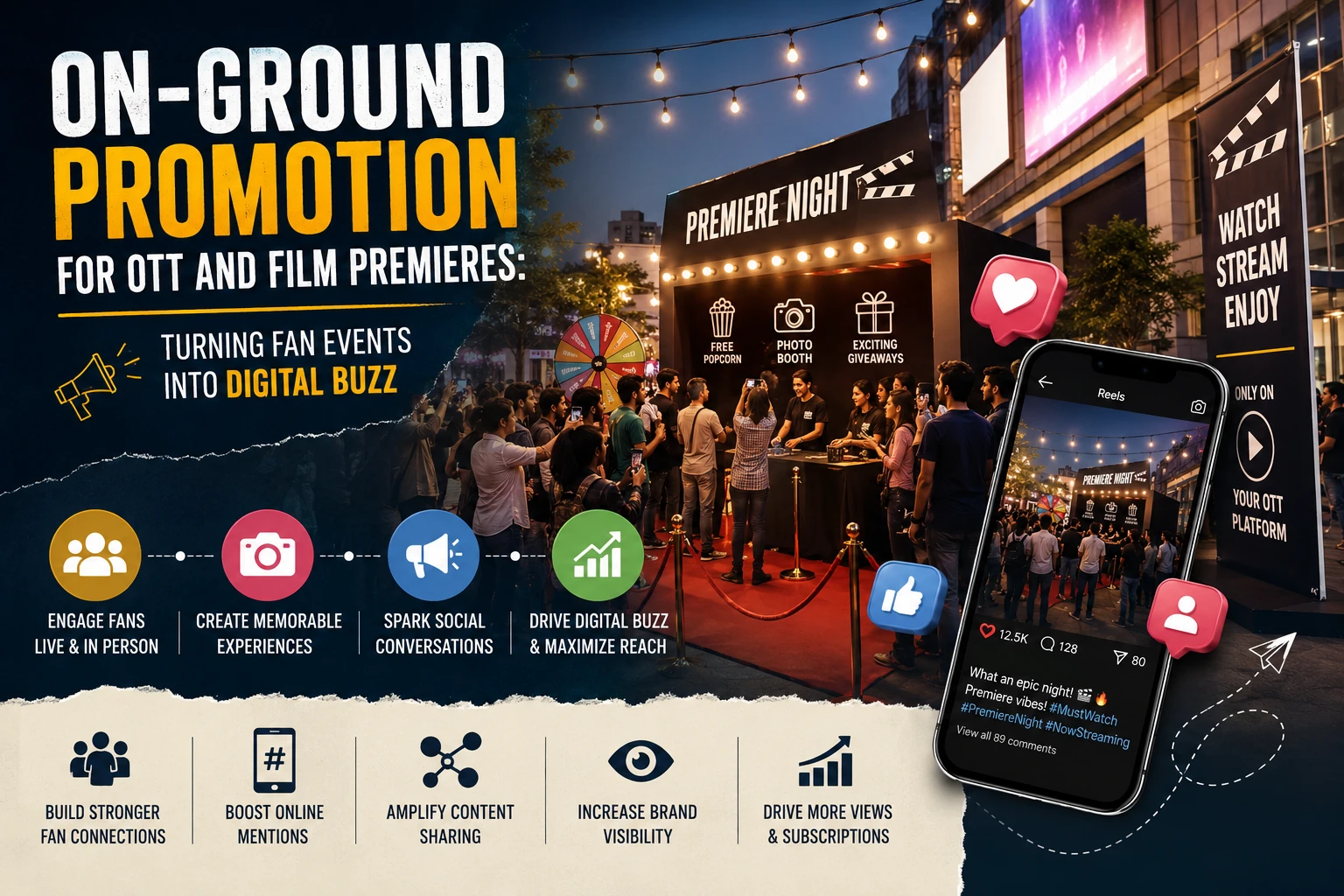
On-Ground Promotion for OTT and Film Premieres: Turning Fan Events Into Digital Buzz
A premiere event has maybe two or three hours of physical existence. What happens after — the photos, the clips, the reactions, the memes — determines whether that event was worth the budget at all. The best entertainment marketing teams don't treat the on-ground event as the campaign. They treat it as the raw material for a much longer digital campaign that starts the moment the first attendee posts their first story.
This is the specific discipline of on-ground promotion for OTT and film launches: designing a physical fan experience deliberately built to travel online, rather than staging an event and hoping the internet notices.
Why On-Ground Events Matter Even in a Streaming-First World
It seems almost contradictory — content that lives entirely on a screen, promoted through a physical, in-person event. But that contradiction is exactly the point. Streaming platforms and films compete for attention inside an infinite, low-friction scroll. An on-ground event breaks that pattern entirely: it asks fans to show up, wait in line, and be physically present for something — and that costs them something a screen tap never does. That cost is what makes the resulting content feel authentic rather than manufactured.
This is also why on-ground fan events consistently outperform pure digital promotion for generating organic buzz. Content created by an actual attendee — someone who stood in that line, saw that installation, met that cast member — carries a credibility that a paid ad or even an influencer's sponsored post doesn't fully replicate.
What Great OTT and Film Premiere Activations Actually Look Like
Netflix's Tudum: Turning a Global Fan Event Into Local Hype
Netflix's global fan event, Tudum, brings trailers, cast appearances, and exclusive first-look content to a dedicated fan audience — and Indian titles have gotten genuine spotlight treatment inside it, with shows like The Archies and Killer Soup featured alongside major global titles. The lesson here isn't the scale of Tudum itself, which most brands can't replicate — it's the underlying principle: Netflix doesn't just promote a release, it stages the release as an event with its own anticipation-building lead-up, teaser drops, and countdown content, giving fans a specific date and moment to organize their online activity around.
Amazon Prime Video's Comicstaan Blue Carpet Screening
For the launch of its comedy series Comicstaan, Amazon Prime Video built a live, streamed "Blue Carpet Screening" hosted by a well-known creator, featuring a real-time Q&A with cast members. Fans could opt into personalized reminder notifications ahead of the livestream simply by engaging with the announcement content — turning pre-event promotion into an active, opt-in audience rather than a passive one. The event's own campaign hashtag topped trending lists, and — notably — the campaign's overall performance exceeded typical event benchmarks by 150% specifically because influencers were built into the promotion from the start, not added afterward as an amplification afterthought.
The Family Man Season 2: Turning Fandom Into a Meme Engine
When Amazon Prime Video needed to revive fan excitement for The Family Man's second season after a two-year gap, the team noticed something specific: fans were already expressing their love for the show primarily through memes. Rather than fighting that instinct, the campaign built a meme-making UGC contest directly into the launch strategy, alongside a first-of-its-kind fictional "job hunt" for the show's lead character that broke the fourth wall of traditional promotion entirely. The campaign leaned into exactly how the existing fandom already talked about the show, instead of introducing a separate, disconnected promotional voice.
Nestlé KitKat x One Piece at Comic Con Mumbai
Outside of pure OTT launches, brand-and-franchise collaborations at fan conventions show the same principle at work. A recent activation recreated an iconic pirate ship from the anime One Piece at Comic Con Mumbai, inviting fans to physically step inside a world they already loved — instead of running a standard branded exhibition stall. The activation worked because it gave fans something to document and share that a normal booth never could.
The Anatomy of a Premiere Activation Built for Digital Buzz
Pull these examples apart, and a consistent structure emerges — a three-stage build that mirrors how on-ground and digital work together generally, adapted specifically for entertainment launches.
Stage 1: Pre-event anticipation (digital)
Teasers, countdowns, behind-the-scenes content, and opt-in reminder mechanics build an audience that's primed to show up — either physically or online — the moment the event begins. This stage is where a campaign hashtag gets established, so there's a single, consistent tag for all the content the event is about to generate.
Stage 2: The activation itself (on-ground)
This is where the shareable moment actually gets built — not left to chance. A photogenic installation, a recognizable character moment recreated physically, a live Q&A, or an interactive format like a costume contest or a themed photo booth all give attendees something specific and structured to capture and post, rather than hoping they organically find something worth photographing.
Stage 3: Amplification (digital again)
Attendee content, influencer coverage, and the platform's own recap posts extend the event's reach far beyond those who physically attended. This is where a well-designed hashtag, a pre-briefed creator presence, and a fast content-editing turnaround (getting official highlight reels out within hours, not days) determine whether the buzz compounds or dies out immediately after the event ends.
What Makes a Premiere Activation Actually Shareable
- A specific, photogenic moment — not just a branded backdrop. A recreated scene, an interactive installation, or a recognizable character meet-and-greet gives people something structured to capture, rather than a generic step-and-repeat banner.
- A built-in reason to participate, not just observe. Contests, meme challenges, and UGC mechanics — like The Family Man's meme contest — turn fans into active contributors instead of passive attendees.
- Creators and influencers present from the planning stage, not bolted on after. The Comicstaan campaign's outsized performance was directly tied to influencer involvement being part of the original plan, not an afterthought layered on top of a finished event.
- A single, consistent hashtag or campaign tag. Fragmented tagging can dilute the digital footprint of an otherwise successful event — please decide the tag before the event and put it everywhere fans will see it.
- Fast official content turnaround. The window where an event is culturally "live" online is short. Official recap content, best-moment clips, and highlight reels need to go out within hours of the event, not days later once the conversation has moved on.
Common Mistakes in Premiere and Fan Event Marketing
- Treating the event as the finish line. The event is the raw material for the campaign, not the campaign itself — without a deliberate amplification plan, most of an event's potential reach never materializes.
- Generic photo-op moments. A plain branded backdrop generates far less shareable content than a specific, recognizable, on-theme installation fans actually want to be seen next to.
- No opt-in mechanism before the event. Amazon's reminder-tweet mechanic for Comicstaan turned interested fans into an activated audience before the event even started — skipping this step leaves awareness passive instead of participatory.
- Ignoring how the existing fandom already communicates. The Family Man's meme-contest approach worked because it matched how fans were already expressing their fandom, rather than introducing an unfamiliar promotional format.
- Slow content turnaround after the event. By the time official highlight content goes out days later, the organic conversation has usually already moved on to the next thing.
A Planning Checklist for OTT and Film Premiere Activations
- Set the hashtag and campaign tag before anything else is planned, and build it into every piece of pre-event content.
- Design at least one specific, photogenic, on-theme moment attendees will want to document — not a generic backdrop.
- Brief creators and influencers into the plan from day one, not as an add-on once the event is designed.
- Build an opt-in mechanism — a reminder signup, a pre-event contest entry — so pre-event promotion converts into an activated, tracked audience.
- Staff a same-day content team to edit and release official recap and highlight content within hours of the event wrapping.
- Match the activation format to how the existing fandom already engages — memes, theories, fan art, cosplay — rather than introducing a disconnected new format.
FAQs on On-Ground Promotion for OTT and Film Premieres
Why do OTT platforms invest in physical premiere events when the content is entirely digital?
Because physical events generate a kind of organic, credible content — attendee photos, reactions, and posts — that paid digital promotion alone can't replicate, and that authenticity extends the campaign's reach well past the people who physically attended.
What makes a premiere event actually generate digital buzz, versus just being a nice event?
A specific, photogenic, on-theme moment worth documenting, a consistent campaign hashtag, creators involved from the planning stage, and fast official content turnaround after the event — events missing these elements tend to stay contained to whoever attended in person.
Should influencers be invited to attend, or briefed to create specific content?
Both work, but campaigns that brief influencers into the plan from the start — rather than simply inviting them and hoping for coverage — consistently outperform ones that treat influencer presence as an afterthought.
How soon after a premiere event should official content go out?
As close to same-day as possible. The window where an event feels culturally "live" online is short, and official highlight content released days later usually misses the peak of the organic conversation.