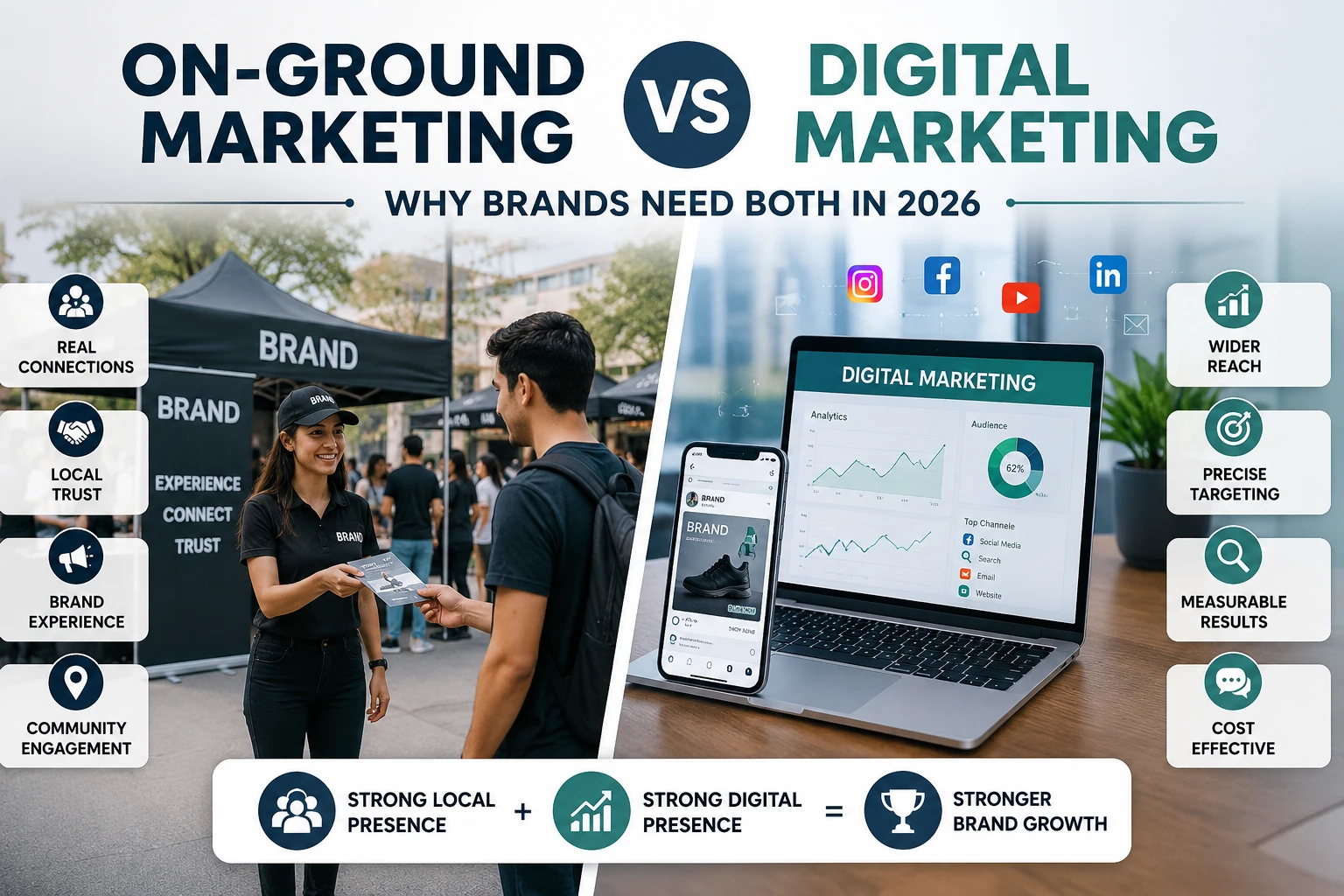
On-Ground Marketing vs Digital Marketing: Why Brands Need Both in 2026
Every marketing budget conversation eventually runs into some version of the same question: should this money go toward digital, or toward on-ground activation? It's usually framed as a competition — pick the channel with the better ROI and put everything there. But the brands actually winning in 2026 have mostly stopped asking the question that way. They're not choosing between on-ground and digital; they're building campaigns where each one does the job the other can't.
Here's an honest look at what each channel is actually good at, where they genuinely compete for budget, and how to combine them instead of picking one.
What Each Channel Is Actually Built For
Digital marketing is built for scale, speed, and precision targeting. A single campaign can reach millions of people, adjust in real time based on performance data, and target audiences down to specific interests, behaviors, or purchase intent — all at a cost per impression that on-ground activity generally can't match at that volume.
On-ground marketing is built for depth, trust, and physical proof. It can't match digital's reach, but it earns something digital structurally can't: a person's full, undistracted attention, a physical interaction with the product, and — increasingly — content that then travels back into the digital world through the people who experienced it firsthand.
Neither is a strictly "better" channel. They're solving different problems in the funnel.
Where the Two Channels Actually Compete
To be fair to the "pick one" instinct, there are real areas where digital and on-ground genuinely compete for the same budget and the same goal:
- Pure awareness campaigns in a hurry, where digital's speed and scale usually win on cost efficiency.
- Highly measurable, fast-iterating campaigns, where digital's real-time data and quick optimization loop outperform the slower planning cycle on-ground execution requires.
- Broad, geographically dispersed audiences, where on-ground's city-by-city execution model is inherently less efficient than a digital campaign that can reach the same footprint instantly.
For campaigns that are purely about awareness at maximum scale on a tight budget, digital genuinely does more of the job on its own. The comparison only breaks down once the goal shifts to trust, conversion, or long-term brand equity — which is most of what marketing actually needs to accomplish.
Where On-Ground Wins That Digital Structurally Can't
Attention that digital can't buy at scale
An on-ground activation earns a dedicated attention span in a way a scrollable ad fundamentally cannot — there's no swiping past a live experience the way there's no cost to skipping a sponsored post. Nielsen research has found consumers are significantly more likely to recall a brand after an experiential event compared to a digital ad, and a large majority say interacting with a brand in person increases their trust in it.
Direct product proof
For categories where the product needs to be tasted, touched, tried on, or demonstrated, no digital format fully replaces physical proof. Sampling activations in food and beverage can convert 60–80% of footfall into trial — a number no digital ad format comes close to for driving actual product experience.
First-party data that isn't dependent on tracking
Registration forms, on-site QR interactions, and post-event surveys build an owned data asset that doesn't depend on cookies, pixel tracking, or platform algorithms — an increasingly valuable property as third-party tracking gets harder across digital advertising.
Where Digital Wins That On-Ground Structurally Can't
Reach and frequency at a fraction of the cost per person
No on-ground activation can put a message in front of millions of people within hours the way a well-targeted digital campaign can — and it can't do it at a comparable cost per person reached.
Real-time optimization
A digital campaign can be adjusted mid-flight based on what's actually converting — creative, audience, or budget can shift within hours. An on-ground activation, once planned and executed in a specific city on a specific date, can't be re-targeted the same way once it's underway.
Precision targeting
Digital platforms allow granular targeting by behavior, interest, and purchase intent that no physical activation can replicate — an on-ground activation reaches whoever shows up at that location, not a precisely defined segment.
Why "Phygital" Is the Real 2026 Strategy
The most useful framing for 2026 isn't on-ground versus digital — it's the two working across the same customer journey, sometimes called a "phygital" approach. In practice, that plays out in three connected stages:
- Anticipation (digital): Pre-event content, influencer teasers, and targeted ads build excitement and drive attendance before an activation even happens.
- Participation (on-ground): The activation itself creates the emotional memory and physical proof digital alone can't deliver.
- Amplification (digital again): Post-event content — photos, videos, creator posts, and attendee UGC — extends the on-ground moment's reach and cultural relevance far beyond whoever physically attended.
This cycle is sometimes described as a "fan-love flywheel" — a compounding system where each stage strengthens the next, and repeated cycles build brand affinity in a way neither channel achieves as effectively alone. Brands increasingly plan influencer and content strategy around on-ground activations specifically so the physical moment generates real digital amplification, rather than treating the two as separate line items on a budget sheet.
A Practical Framework for Splitting Budget
There's no universal ratio, but a few questions help determine the right split for a given brand or campaign:
- What's the actual goal? Pure awareness at scale → weight digital. Trust-building, trial generation, or premium brand positioning → weight on-ground.
- Does the product benefit from physical proof? Food, beverage, beauty, and other sensory or trial-driven categories generally see outsized returns from on-ground sampling relative to digital ads alone.
- What stage is the brand in? Newer D2C and FMCG brands often lean more heavily into on-ground (sometimes 15–25% of total spend) in their first 24 months specifically to build initial trial and local market presence, then shift toward a more balanced or digital-weighted mix as brand awareness matures.
- Is there a real amplification plan? An on-ground activation with no digital extension plan wastes most of its potential reach; a digital campaign with no on-ground presence in a physical-proof category misses out on trust-building it can't otherwise buy.
Common Mistakes When Choosing Between the Two
- Treating them as competing line items instead of connected stages. The brands getting the most value from either channel are the ones sequencing them together, not picking one and abandoning the other.
- Judging on-ground purely on digital metrics. Impressions and CPMs undersell what on-ground actually delivers — trust, recall, and conversion need their own measurement framework, not a digital one force-fit onto a physical activation.
- Skipping the digital amplification plan for an on-ground activation. A brilliant activation with no creator briefing, no content plan, and no hashtag strategy leaves most of its potential value on the table.
- Over-indexing on scale for categories that need proof. Some products simply convert better through direct trial than through any amount of digital ad spend — running only digital for those categories under-delivers on conversion regardless of targeting quality.
FAQs on On-Ground vs Digital Marketing
Is digital marketing cheaper than on-ground marketing?
Generally yes, on a pure cost-per-impression basis — digital can reach far more people per rupee spent. But on-ground marketing often delivers meaningfully higher recall, trust, and trial conversion per person reached, which changes the calculation depending on the actual campaign goal.
Should small or new brands prioritize digital or on-ground first?
It depends on the category. Product-trial-driven categories like food, beverage, and beauty often see strong early ROI from on-ground sampling even on a limited budget, while categories that don't require physical trial typically get more initial traction from targeted digital campaigns.
What is "phygital" marketing?
It's the practice of designing physical (on-ground) and digital marketing to work together across a single campaign — using digital to build anticipation before an activation and amplify it afterward, with the on-ground activation itself providing the core experience in between.
Can a brand run a successful campaign using only one channel?
Yes, particularly for narrow, single-goal campaigns — but most brands trying to build lasting awareness, trust, and conversion see stronger overall results by combining both rather than relying on either channel alone.