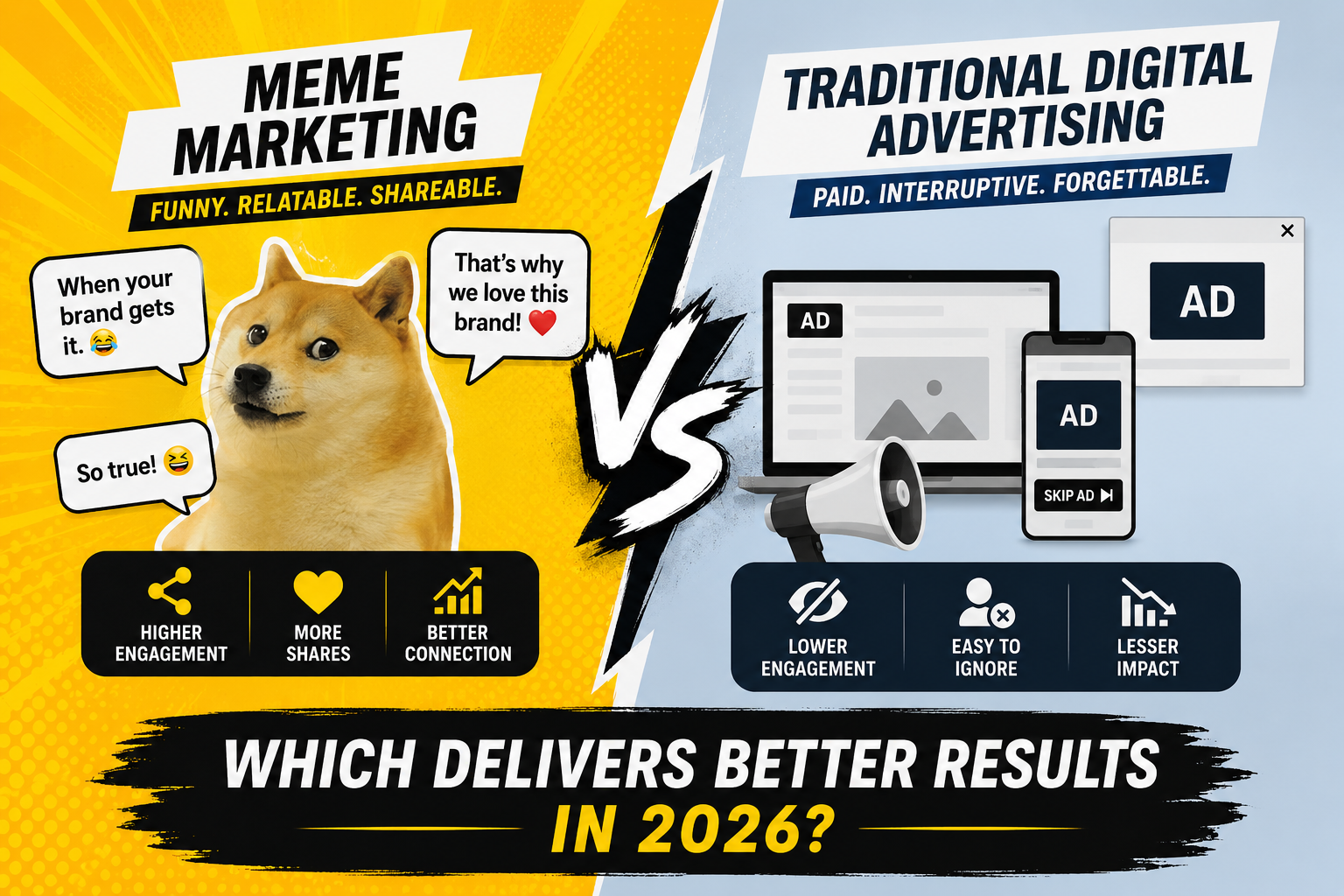
Meme Marketing vs Traditional Digital Advertising: Which Delivers Better Results in 2026?
The digital marketing landscape has undergone a dramatic transformation over the last decade. Consumers today are exposed to countless advertisements across social media, websites, search engines, and streaming platforms. As attention spans continue to shrink, brands face a growing challenge: how do you stand out in a crowded digital environment?
While traditional digital advertising remains a powerful marketing channel, a newer strategy has emerged as a favorite among modern brands—meme marketing. What was once considered internet humor has evolved into a serious marketing tool capable of generating massive engagement and organic reach.
As businesses evaluate where to invest their marketing budgets, the debate between meme marketing and traditional digital advertising has become more relevant than ever. Many brands are even partnering with a professional meme marketing agency to capitalize on viral content and social media culture.
So, which strategy delivers better results in 2026? Let's compare them across key marketing metrics.
Understanding Traditional Digital Advertising
Traditional digital advertising includes paid promotional campaigns across platforms such as:
- Google Ads
- Facebook Ads
- Instagram Ads
- LinkedIn Ads
- YouTube Ads
- Display Advertising Networks
These campaigns are designed to reach specific audiences through paid placements. Advertisers control targeting, messaging, budgets, and campaign objectives.
Traditional digital advertising focuses on driving measurable outcomes such as:
- Website traffic
- Lead generation
- App installs
- Online sales
- Brand awareness
While highly effective, it often requires ongoing budget allocation to maintain visibility.
What Is Meme Marketing?
Meme marketing uses humorous, relatable, and culturally relevant content to engage audiences. Instead of directly promoting products, memes entertain users while subtly communicating a brand message.
The success of meme marketing lies in its ability to feel organic rather than promotional. Consumers willingly engage with meme content because it aligns with how they naturally interact online.
A skilled meme marketing agency understands internet trends, audience behavior, and social media culture, helping brands create content that resonates and spreads organically.
Audience Attention: Who Wins?
One of the biggest challenges in marketing is capturing audience attention.
Traditional digital ads often interrupt the user experience. Whether it's a YouTube pre-roll ad or a sponsored social media post, consumers know they are being marketed to.
Memes, on the other hand, blend naturally into social feeds. They resemble the content users already consume and share daily.
Traditional Digital Advertising:
- Often perceived as promotional
- Can be skipped or ignored
- Faces increasing ad fatigue
Meme Marketing:
- Feels native to social platforms
- Encourages voluntary engagement
- Naturally attracts attention
Winner: Meme Marketing
In a world where consumers actively avoid advertisements, memes offer a less intrusive way to capture attention.
Engagement Rates: Which Strategy Creates More Interaction?
Engagement is one of the most important indicators of marketing success.
Traditional advertisements often generate clicks and impressions but may struggle to inspire meaningful interaction.
Memes are designed to be shared, commented on, and discussed.
Users frequently:
- Tag friends
- Share memes in direct messages
- Repost content
- Participate in conversations
This level of interaction creates stronger audience connections and increases content visibility.
Traditional Advertising:
- Strong click-through opportunities
- Limited organic interaction
Meme Marketing:
- High engagement rates
- Encourages social sharing
Winner: Meme Marketing
For brands focused on engagement and community building, memes often outperform traditional advertising formats.
Cost Efficiency: Which Provides Better ROI?
Marketing budgets are always under scrutiny.
Traditional digital advertising operates on a pay-to-play model. Brands must continually spend money to maintain visibility.
Costs can increase significantly due to:
- Competitive bidding
- Rising CPC rates
- Increasing CPM costs
Meme marketing often requires lower production costs while generating substantial organic reach.
A well-executed meme can reach thousands—or even millions—of users without requiring extensive ad spend.
Traditional Advertising:
- Requires continuous budget investment
- Predictable scalability
Meme Marketing:
- Lower content production costs
- Potential for viral reach
Winner: Meme Marketing
From a cost-efficiency perspective, meme marketing often provides exceptional value.
Targeting Capabilities
This is where traditional digital advertising has a clear advantage.
Advertising platforms offer advanced targeting options based on:
- Demographics
- Interests
- Location
- Purchase behavior
- Device usage
- Online activity
Brands can precisely reach their ideal customers.
Meme marketing relies more heavily on audience resonance and organic sharing.
While memes can reach broad audiences, targeting is generally less precise.
Traditional Advertising:
- Highly targeted
- Data-driven optimization
Meme Marketing:
- Broader organic distribution
- Less direct audience control
Winner: Traditional Digital Advertising
When precise audience targeting is required, traditional advertising remains superior.
Building Brand Personality
Consumers increasingly prefer brands that feel authentic and relatable.
Traditional advertising often follows structured brand guidelines and promotional messaging.
Memes allow brands to showcase personality, humor, and cultural awareness.
Many of today's most successful brands have built strong online communities through relatable meme content.
A professional meme marketing agency helps brands strike the right balance between entertainment and brand messaging.
Traditional Advertising:
- Professional and polished
- Strong message control
Meme Marketing:
- Humanizes brands
- Builds stronger emotional connections
Winner: Meme Marketing
For relationship building and brand personality development, memes have a distinct advantage.
Speed and Adaptability
The digital world moves quickly.
Traditional advertising campaigns often involve:
- Creative development
- Approval processes
- Campaign setup
- Testing periods
This can slow down execution.
Memes can be created and published within hours, allowing brands to react instantly to trending conversations and viral moments.
Traditional Advertising:
- Longer production cycles
- Structured execution
Meme Marketing:
- Fast turnaround
- Real-time trend participation
Winner: Meme Marketing
Speed is essential in modern marketing, and memes excel in this area.
Measuring Results
Traditional digital advertising offers sophisticated analytics and reporting.
Brands can track:
- Click-through rates
- Conversion rates
- Cost per acquisition
- Return on ad spend
Meme marketing metrics typically focus on:
- Engagement
- Shares
- Reach
- Brand sentiment
While measurable, meme marketing can sometimes make direct attribution more challenging.
Traditional Advertising:
- Clear performance metrics
- Conversion tracking
Meme Marketing:
- Strong engagement insights
- Less direct attribution
Winner: Traditional Digital Advertising
For detailed performance analysis, traditional advertising remains the leader.
Why Smart Brands Use Both
The reality is that meme marketing and traditional digital advertising are not competitors—they are complementary strategies.
Successful brands often use:
Meme Marketing For:
- Engagement
- Brand awareness
- Community building
- Organic reach
Traditional Advertising For:
- Lead generation
- Sales campaigns
- Retargeting
- Precise audience targeting
Combining both approaches creates a balanced marketing strategy that drives both awareness and conversions.
Many businesses now partner with a specialized meme marketing agency while simultaneously running paid advertising campaigns to maximize results.
The Future of Digital Marketing
As consumers become increasingly resistant to traditional advertisements, brands will continue searching for authentic ways to connect with audiences.
Meme marketing is expected to grow significantly because it aligns with modern content consumption habits. However, traditional digital advertising will remain essential for driving measurable business outcomes.
The most successful brands in 2026 are those that leverage both creativity and performance marketing to achieve their goals.
Conclusion
When comparing meme marketing and traditional digital advertising, there is no one-size-fits-all answer. Each strategy serves a unique purpose within a broader marketing ecosystem.
Meme marketing excels at capturing attention, generating engagement, building brand personality, and creating organic reach. Traditional digital advertising remains unmatched for targeting, tracking, and conversion-focused campaigns.
Rather than choosing one over the other, forward-thinking brands are integrating both strategies to maximize visibility and business growth. Working with an experienced meme marketing agency can help businesses harness the power of internet culture while maintaining alignment with broader marketing objectives.
In 2026, the brands that balance creativity with data-driven advertising will be the ones that stand out, engage audiences, and achieve sustainable growth.