Meme Marketing vs Influencer Marketing: Which Works Better for Your Brand?
Introduction
Every marketing budget conversation eventually lands on the same question: memes or influencers? Both promise reach. Both promise virality. But they work through completely different mechanics, and picking the wrong one for your goal can quietly burn budget without moving the needle.
This isn't really an either/or decision — the smartest brands use both, but for different jobs. Here's a clear breakdown of meme marketing vs influencer marketing, so you know exactly where each one earns its place in your strategy.
What Meme Marketing Actually Does
Meme marketing places your brand, product, or message inside content that already feels native to how people scroll — funny, relatable, low-effort-to-consume, high-effort-to-ignore. It typically runs through established meme pages with large, highly engaged followings, or through a brand's own reactive social content.
Strengths:
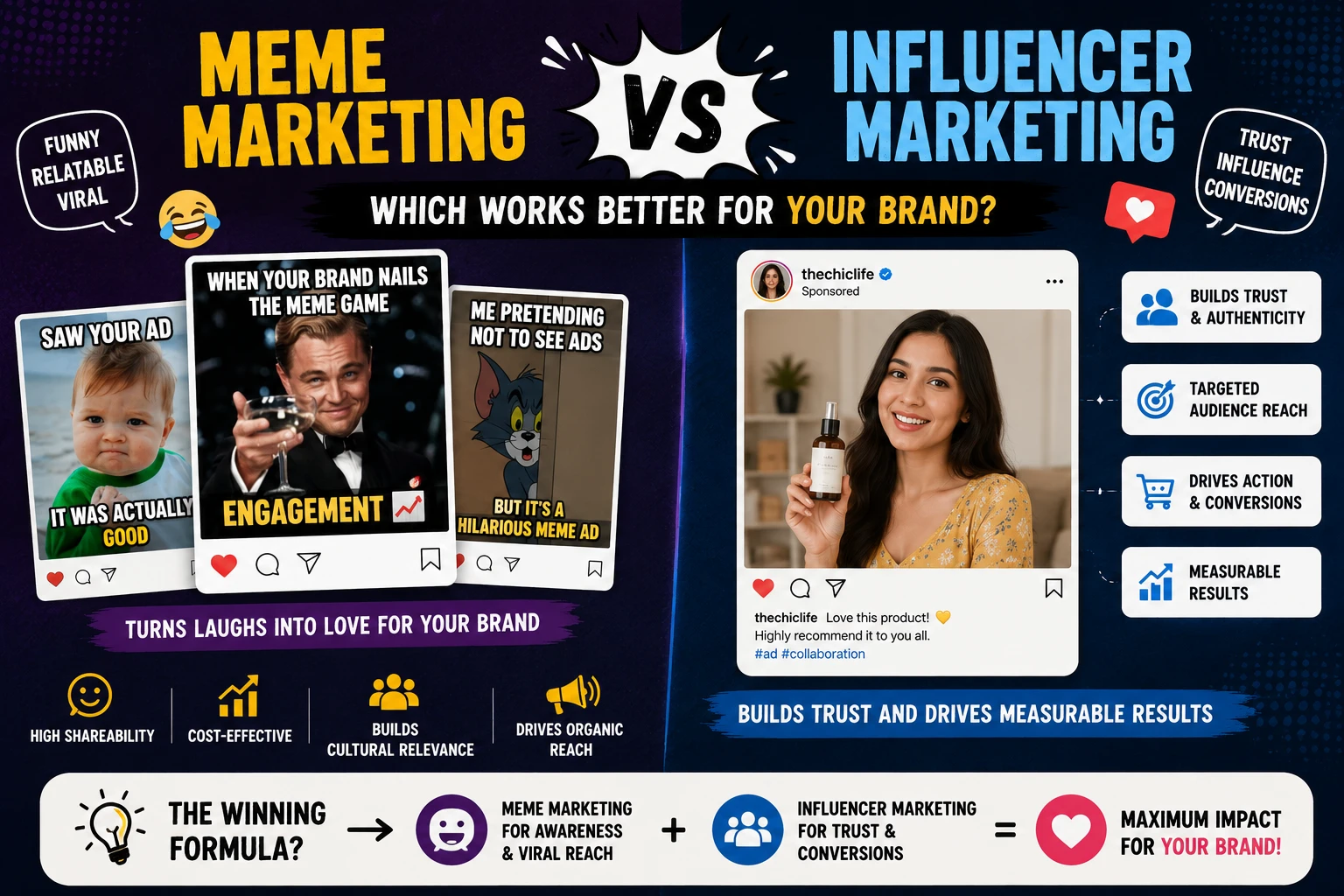
- Extremely cost-effective relative to reach — a single meme placement can outperform a costly ad in shares and comments
- Fast turnaround — memes can go live within hours of a trend or cultural moment
- High shareability — humor travels faster and further than most other content formats
- Builds cultural relevance — brands that meme well are seen as "in on the joke," not just advertising
Limitations:
- Harder to sustain a consistent brand voice across viral, fast-moving content
- Less effective for deep product education or high-consideration purchases
- Requires genuine cultural fluency — a poorly timed or tone-deaf meme can backfire
What Influencer Marketing Actually Does
Influencer marketing borrows the trust an individual has already built with their audience. Instead of a brand talking at people, an influencer talks to their community, with the brand woven into that conversation.
Strengths:
- Built-in trust — audiences already believe the influencer's opinion matters
- Better for storytelling — ideal for demonstrating product use, unboxing videos, tutorials, or detailed reviews
- Stronger for conversion-focused campaigns — especially with niche or micro-influencers whose audiences are highly targeted
- Long-term relationship potential — repeated collaborations compound brand affinity over time
Limitations:
- Costs scale quickly, especially with macro and celebrity-tier influencers
- Slower production timelines compared to reactive meme content
- Reach and results can be harder to predict — heavily dependent on the individual influencer's current engagement health
Head-to-Head Comparison
Factor | Meme Marketing | Influencer Marketing |
| Cost | Low to moderate | Moderate to high |
| Speed to launch | Hours to days | Days to weeks |
| Trust factor | Cultural/community trust | Personal/parasocial trust |
| Best for | Awareness, virality, brand personality | Consideration, conversion, product education |
| Content lifespan | Short, high-intensity burst | Longer, can be repurposed |
| Scalability | High — can flood multiple pages/formats | Limited by influencer bandwidth |
| Risk of backlash | Higher if humor misfires | Lower, but tied to influencer's reputation |
When Meme Marketing Wins
- Launching a new product and need fast, low-cost buzz
- Promoting time-sensitive content (like an OTT release, app launch, or event)
- Your target audience is younger, internet-native, and highly online (Gen Z, urban millennials)
- You want to build a distinct, relatable brand personality rather than push a hard sell
When Influencer Marketing Wins
- You're selling something that benefits from demonstration or explanation
- Trust and credibility matter more than raw reach (skincare, finance, health, tech)
- You're targeting a specific niche audience an influencer has already built
- You want content that can be repurposed as long-term brand assets (reviews, testimonials, tutorials)
The Case for Using Both Together
The strongest campaigns rarely pick a side. A common and highly effective structure looks like this:
- Meme marketing builds the buzz — fast, culturally relevant awareness that gets people talking
- Influencers add credibility and depth — turning that awareness into trust and consideration
- Both funnel into performance marketing — retargeting the audience that engaged with either format
This layered approach captures the speed and virality of memes alongside the trust and storytelling depth of influencers — giving a brand both top-of-funnel reach and mid-funnel conversion support.
Final Thoughts
There's no universal winner between meme marketing and influencer marketing — the right choice depends on your goal, timeline, and audience. If you need fast, culturally relevant buzz on a lean budget, memes usually win. If you need trust-driven storytelling that moves someone toward a purchase, influencers usually win. For most brands, the real advantage comes from knowing how to combine both rather than choosing one permanently.