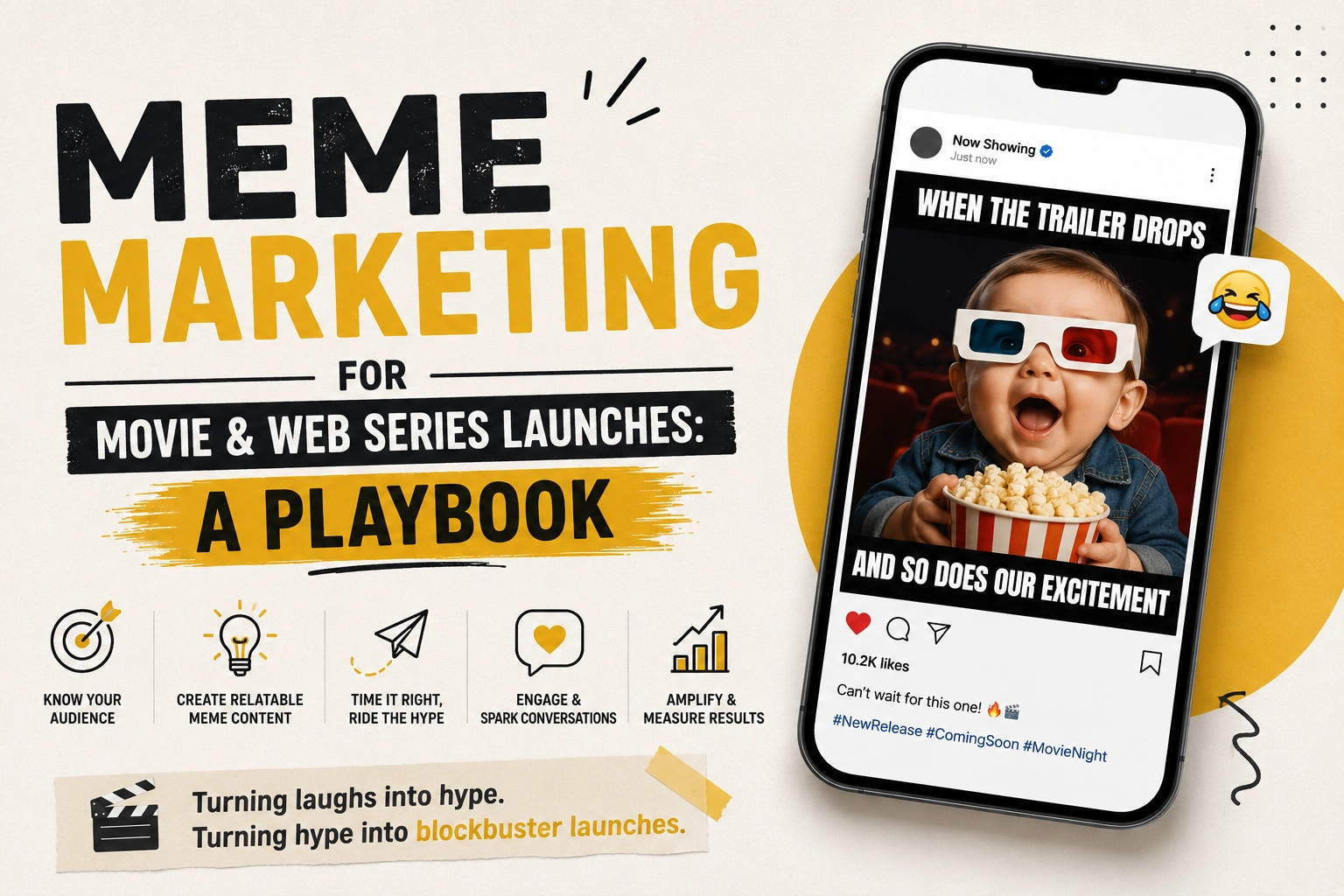
Meme Marketing for Movie & Web Series Launches: A Playbook
A trailer can be perfectly cut, scored, and edited — and still get five million fewer views than a single well-timed meme built from one line of dialogue. That's the reality of entertainment marketing in India today: memes now travel faster than the promotional content studios and streaming platforms actually pay for.
This playbook breaks down how meme marketing actually works across a movie or web series launch — not just as one-off jokes, but as a structured layer of the release calendar, from the first teaser to weeks after the premiere.
Why Meme Marketing Works Especially Well for Entertainment Launches
Movies and web series have a structural advantage most brands don't: built-in characters, dialogue, and moments that are already emotionally loaded before a single meme is made. A punchline only needs a caption. A character's expression only needs a relatable context. The content already exists — meme marketing's job is just to extract it and put it in front of people who haven't watched yet.
This is also why entertainment meme marketing tends to outperform straightforward promotion. As one industry analysis of Hindi web series marketing put it, if the meme built from a show's content looks good on its own, the underlying show automatically becomes appealing to people who haven't seen it — the meme sells the show before the trailer does. Amazon Prime Video's Sacred Games and Mirzapur are two of the most-cited examples of this in India: both shows have such distinct characters and dialogue that meme pages could stretch their moments into jokes long after release, keeping the shows culturally present well beyond their launch week.
The Meme Marketing Timeline for a Launch
Meme marketing for entertainment isn't a single push at release — it works in four distinct phases, each with a different goal.
Phase 1: Pre-release seeding (6–8 weeks before launch)
Before the trailer even drops, get early cuts, teaser clips, or behind-the-scenes moments in front of meme pages and creators who work in the film's genre. The goal here isn't virality yet — it's giving meme-makers raw material to start speculating, reacting, and building anticipation before the official campaign begins. Streaming platforms increasingly share early trailers and exclusive clips with select creators specifically so this reaction content starts circulating organically, weeks ahead of the public release.
Phase 2: Trailer-drop amplification (0–2 weeks after trailer)
This is the highest-leverage window. The moment a trailer or key scene goes public, meme creators move fast to turn memorable dialogue or expressions into shareable formats — and this content spreads faster than official promotional posts because it feels like a joke, not an ad. Have a pre-briefed network of meme pages ready to go the same day the trailer drops, not a week later once the moment has already peaked.
Phase 3: Opening-week momentum (release week)
Once the film or show is out, the content shifts from "should I watch this" to "everyone's already talking about this." This is where reaction memes, dialogue remixes, and character comparisons peak — and where a meme marketing agency can coordinate simultaneous drops across dozens of pages to make the show feel inescapable, rather than relying on organic spread alone.
Phase 4: Long-tail cultural presence (weeks to months after)
The best entertainment memes outlive their release window entirely. Dialogue from Sacred Games and Mirzapur has shown up in memes years after both shows premiered — and, notably, has been picked up by brand advertising itself. Recent Indian ad campaigns have directly recreated iconic OTT and film characters — Shah Rukh Khan's Raees, Alia Bhatt's Gangubai, Pratik Gandhi's Harshad Mehta from Scam 1992, and the Munnabhai-Circuit duo have all appeared in brand ads that replicate the original character's look, body language, and dialogue delivery almost exactly. That's the long-tail payoff of a strong meme presence: the content becomes reusable cultural shorthand long after the box office numbers are reported.
Formats That Work for Entertainment Meme Marketing
- Dialogue remixes: A single memorable line, recontextualized into unrelated everyday situations — the format responsible for most of the long-tail meme life Sacred Games and Mirzapur still enjoy.
- Character-as-relatable-mood memes: Using a character's expression or reaction shot as a stand-in for a common feeling ("me on Monday morning" energy), which spreads even among people who haven't watched the source material.
- Creator reaction and prediction content: Comedy and entertainment creators reacting to trailers or theorizing about plot points, which the influencer-marketing playbook for OTT launches treats as a core pre-release tactic — a creator's genuine reaction often drives more curiosity than a polished promo.
- Trend-jacking existing formats: Fitting a film or show's characters into whatever meme template is already trending that week, rather than starting from a blank page.
- Cross-promotional cameos: Brands borrowing a currently-trending character for their own advertising — a two-way trade where the brand gets cultural relevance and the show gets another round of visibility.
Building the Campaign: A Practical Checklist
- Identify your meme-able assets early. Before the trailer is even locked, flag which lines, expressions, or moments are likely to travel — meme marketing works best when it's planned into the release, not bolted on afterward.
- Map your meme page network to genre and audience. A crime-thriller web series and a rom-com need completely different pages and creator types. Match the content pocket to the show, not just to overall follower count.
- Pre-brief pages before the trailer drops. Don't wait for the trailer to go live before reaching out to meme pages — have the content, angle, and page list approved in advance so drops can go out within hours, not days, of the trailer's release.
- Coordinate timing across pages. A single meme is a moment; twenty meme pages posting related content within the same 48 hours is a cultural takeover. Sequencing matters as much as the content itself.
- Track engagement, not just reach. Saves, shares, and comment volume are better predictors of whether a meme is actually driving curiosity about the show than raw impressions.
- Keep a lane open past release week. Budget a smaller, ongoing meme presence for weeks after launch — this is what keeps dialogue and characters in circulation long enough to become the kind of cultural shorthand that shows up in brand ads months later.
Common Mistakes to Avoid
- Waiting until release day to start. By the time a meme feels obvious enough for a brand's internal team to greenlight it, meme pages have usually already moved past that trend.
- Over-scripting the joke. The more a meme reads like official marketing copy, the less it travels — the best entertainment memes barely look like promotion at all.
- Ignoring genre fit. A meme format built for a comedy won't land the same way for a dark thriller — mismatched tone is one of the fastest ways to make a promotional meme feel forced.
- Treating it as a one-week campaign. The shows that stay culturally relevant — Sacred Games, Mirzapur, Scam 1992 — are the ones whose meme presence kept going long after the premiere, not the ones that peaked and disappeared.
FAQs on Meme Marketing for Movie & Web Series Launches
When should meme marketing start for a movie or web series launch?
Ideally 6–8 weeks before release, seeding early clips and reaction content with meme pages and creators — well before the trailer's official drop, not after it.
Does meme marketing work for all genres, or just comedies?
It works across genres, but the format needs to match the tone. Crime thrillers and dramas tend to work well with dialogue-remix and character-as-mood formats, while comedies can support more direct, punchline-driven memes.
How is meme marketing different from influencer marketing for OTT launches?
Influencer marketing relies on a creator's personal reaction or review to build trust and curiosity, while meme marketing relies on relatable, shareable content — often built directly from the show's own footage or dialogue — spreading across dedicated meme pages and accounts.
Can meme marketing outlive the release window?
Yes — some of the most successful examples in India, including dialogue from Sacred Games and Mirzapur, have stayed in circulation for years and even influenced how brand advertising borrows entertainment characters long after original release.