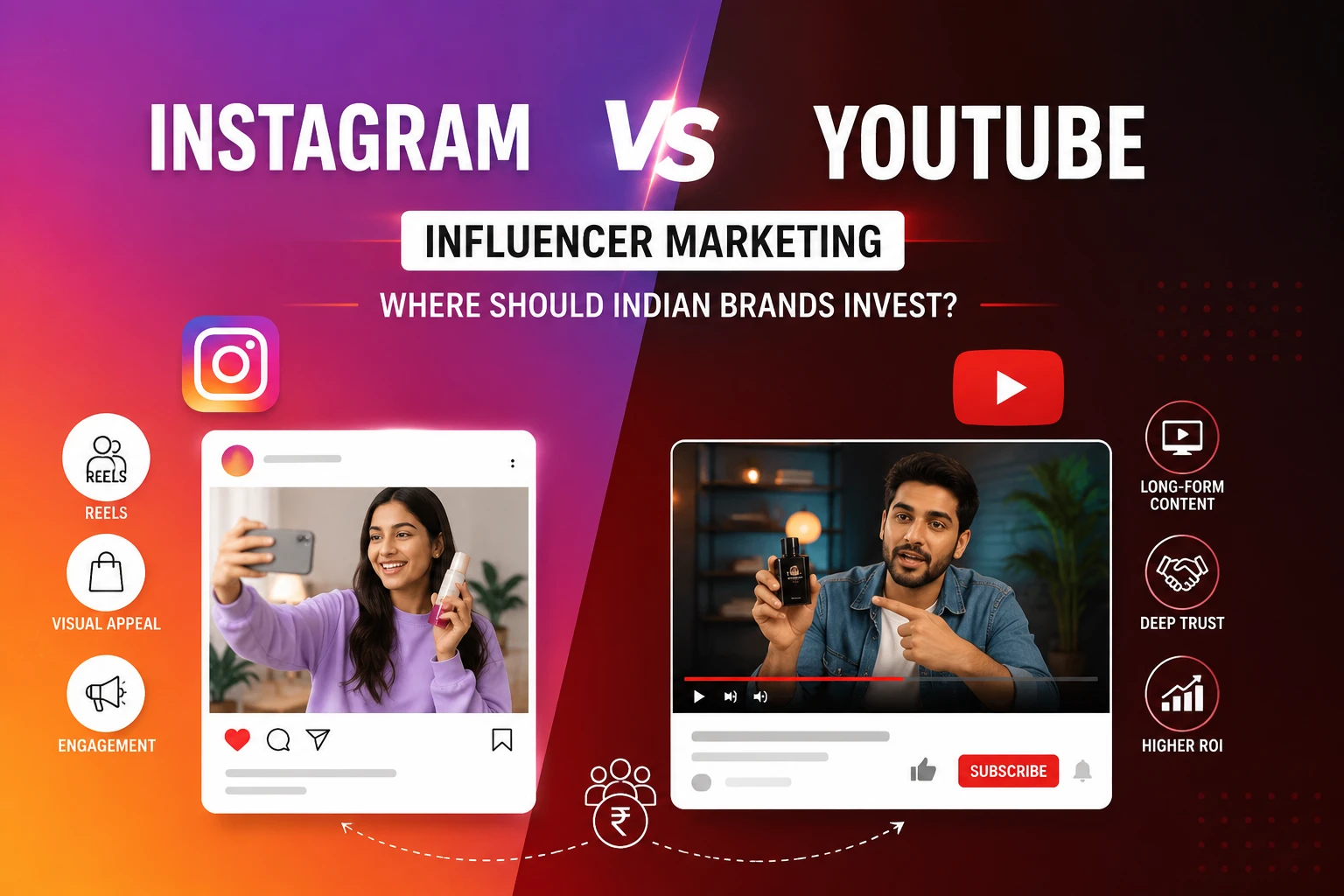
Instagram vs YouTube Influencer Marketing: Where Should Indian Brands Invest?
India's influencer marketing industry is projected to keep growing at a rapid clip through 2026, and most of that budget still gets split between two platforms: Instagram and YouTube. But "split" is doing a lot of work in that sentence — the two platforms don't compete for the same job. Instagram wins on speed, discovery, and immediate engagement; YouTube wins on search, trust, and content that keeps working long after it's published.
Choosing between them isn't really about which platform is "better." It's about understanding what each one is actually good at, and matching that to what your campaign needs to achieve. Here's a straight breakdown.
The Fundamental Difference: Discovery vs. Search
Instagram is largely a discovery and recommendation platform — users open the app without a specific intent and get served content based on what's trending, who they follow, and what the algorithm predicts they'll engage with. YouTube is closer to a search engine users arrive at with a specific question, topic, or creator already in mind, which favors long-form, informative, evergreen content where watch time and retention matter most.
This single difference cascades into almost everything else that separates the two platforms for influencer campaigns.
Content Shelf Life: Where the Real Gap Is
This is the single biggest practical difference for brands, and it's not close.
Instagram Reels typically drive the large majority of their total engagement within the first 24 to 72 hours, after which views decline sharply — meaning visibility depends on posting consistently rather than any single piece of content continuing to work for you. YouTube content, by contrast, is searchable and recommendation-driven — a well-made video can keep earning views, subscribers, and even ad revenue for its creator months or years after upload, especially for evergreen formats like reviews, tutorials, and comparisons.
What this means for brands: an Instagram influencer campaign is closer to a burst of visibility you need to keep renewing. A YouTube influencer campaign, done well, behaves more like an owned asset — a video comparing products or reviewing a service can keep driving discovery and search traffic long after the campaign budget is spent.
Engagement Style and Rate
Engagement tends to run higher on Instagram for lifestyle, fashion, beauty, and entertainment content, where quick, visual, trend-driven formats thrive. YouTube tends to pull ahead for tech, education, and finance content, where audiences are actively searching for depth rather than scrolling passively. Reels also tend to go viral faster — often within 24–48 hours — while YouTube Shorts and long-form content show slower but more sustained growth through search discoverability that can continue well beyond the first week.
Engagement quality also differs in kind, not just volume. Instagram engagement — likes, saves, DM shares — feels more personal and immediate. YouTube engagement, especially comments, tends to be more public and discussion-oriented, and viewers can click straight through to a creator's other, longer content in a way Instagram's single-link bio doesn't easily support.
Cost Comparison: What Indian Brands Actually Pay in 2026
Indian influencer pricing is driven far more by engagement rate and niche than by platform alone, but there are real cost differences worth knowing:
- Nano creators (1K–10K followers): Roughly ₹2,000–₹8,000 per post or Reel, with the highest engagement rates of any tier — often 6–12%. Best for hyperlocal or regional-language campaigns.
- Micro creators (10K–100K followers): Roughly ₹8,000–₹80,000 per deliverable, with engagement rates of 3–7% on Instagram versus 4–9% on YouTube Shorts. This tier is generally considered the sweet spot for D2C brands, often delivering meaningfully better ROI than macro-tier creators for conversion-focused campaigns.
- Macro and mega creators: YouTube creators with 10M+ subscribers typically charge significantly more for integrated, longer-form sponsorships than a comparable Instagram post — reflecting the higher production effort and longer-lasting placement.
- Multi-post packages: Brands can often negotiate meaningful discounts off single-post rates when booking multiple pieces of content from the same creator.
The most common pricing mistake Indian brands make on either platform is paying based on follower count rather than actual engagement rate — a smaller, highly engaged creator frequently delivers more real reach, and costs less, than a larger account padded with inactive or low-quality followers.
Format Fit: What Kind of Content Actually Belongs on Each Platform
- Choose Instagram when: the content is trend-driven, visually led, or benefits from fast, native discovery — outfit hauls, quick recipes, aesthetic product shots, and reactive trend-jacking content all thrive on Instagram's discovery-first model.
- Choose YouTube when: the content is a tutorial, in-depth review, comparison, or anything a buyer would actively search for — YouTube's search-driven, evergreen structure rewards depth in a way Instagram's feed doesn't.
- Use both when: the campaign has enough content to repurpose — a long-form YouTube review can be cut into several Instagram Reels, and a compelling clip or quote from that video can become its own native Instagram post, driving traffic back to the full video.
A Side-by-Side Comparison
YouTube | ||
| Primary use case | Discovery, trend-driven engagement | Search, evergreen, in-depth content |
| Content shelf life | Days | Months to years |
| Typical engagement rate (micro tier) | 3–7% | 4–9% (Shorts) |
| Best content types | Trends, lifestyle, quick visual content | Tutorials, reviews, comparisons |
| Virality speed | Fast (24–48 hours) | Slower, more sustained |
| Monetization for creators | Mostly brand deals | Ad revenue + brand deals |
| Best for | Awareness, trend-jacking, fast campaigns | Consideration, search visibility, long-term ROI |
Where Indian Brands Should Actually Invest
For most brands, this isn't an either/or decision — it's a question of budget allocation based on campaign goal:
If the goal is awareness or a fast product launch: weight budget toward Instagram. Its discovery-first algorithm and faster viral cycle make it better suited to generating quick, high-volume buzz around a launch window.
If the goal is consideration, trust-building, or long-term search visibility: weight budget toward YouTube. A strong, well-optimized creator review or comparison video keeps working as a discoverable asset long after the campaign technically ends — closer to content marketing than a one-off ad.
If the budget allows for both: a hybrid approach tends to outperform either platform alone. A practical starting cadence some Indian marketers use is a higher volume of Instagram Reels alongside a smaller number of YouTube Shorts or long-form videos each week — using Instagram's shorter shelf life to justify more frequent posting, and YouTube's evergreen nature to justify less frequent but higher-production content.
If the brand or product category is inherently visual and impulse-driven (fashion, beauty, food, lifestyle): Instagram will likely deliver more efficient engagement per rupee spent.
If the brand or product category requires explanation or comparison (tech, finance, SaaS, high-consideration purchases like appliances or education): YouTube's search-driven, long-form format tends to build more durable trust and search-referred traffic.
Common Mistakes Brands Make Choosing Between the Two
- Picking a platform based on where the brand's existing followers are, not where the campaign goal fits. A launch campaign needs Instagram's speed regardless of where your own audience currently is; a trust-building campaign needs YouTube's depth regardless of follower count.
- Treating YouTube as "too slow" and skipping it entirely. Slower initial growth is the tradeoff for content that keeps performing — a mistake many performance-focused brands make by only chasing Instagram's faster payoff.
- Applying the same creative brief to both platforms. Repurposing raw footage without adapting format, pacing, and hook style to each platform's actual audience intent under-delivers on both.
- Ignoring engagement rate in favor of follower count. This mistake costs brands real money on both platforms, but it's especially costly with Instagram given how common inflated or low-quality follower bases are among mid-tier creators.
FAQs on Instagram vs YouTube Influencer Marketing in India
Which platform is cheaper for influencer marketing in India?
Neither is uniformly cheaper — pricing depends more on creator tier, niche, and engagement rate than platform. That said, nano and micro-tier Instagram content tends to have a lower entry cost than comparable YouTube integrations, which typically require more production effort.
Should a new D2C brand start with Instagram or YouTube?
Most new D2C brands see faster initial traction on Instagram due to its discovery-first algorithm, but pairing that with even a small YouTube presence — reviews or comparisons — builds a searchable asset that compounds over time in a way Instagram content generally doesn't.
Do Instagram Reels or YouTube Shorts perform better for Indian brands?
It depends on the goal. Reels tend to deliver faster, more personal engagement and quicker viral cycles; Shorts tend to deliver better long-term discoverability and searchability. Many Indian creators and brands now run both, using Reels for fast growth and Shorts for durable reach.
Is it worth running influencer campaigns on both platforms at once?
For brands with enough budget and content to repurpose, yes — a hybrid approach that uses YouTube for depth and Instagram for reach tends to outperform relying on either platform alone.