How to Hire an On-Ground Promotion Agency in India: What to Look For
An on-ground campaign is one of the least forgiving formats to get wrong. Unlike a digital ad you can pause and re-target within hours, a botched mall activation, an under-staffed roadshow, or a permission that falls through the week of launch is a mistake you often can't undo — the date has passed, the budget is spent, and the window is gone.
That makes agency selection the single highest-leverage decision in the entire process. India has hundreds of BTL and experiential marketing agencies, ranging from small local vendors to large pan-India operators — and the gap in execution quality between them is enormous. Here's exactly what to evaluate before signing a contract.
Start With What You Actually Need
Before evaluating any agency, get specific about the campaign itself — this determines which agencies are even worth talking to.
- Geography: A single-city mall activation has very different requirements than a 15-city roadshow. Some agencies have deep strength in one region and thin coverage elsewhere.
- Format: Sampling and demonstrations, campus and RWA activations, large-scale experiential builds, and retail/POS execution all require different specialized capabilities — not every agency is equally strong across all of them.
- Scale and duration: A one-day activation and a multi-week, multi-city campaign call for very different operational muscle, particularly around staffing and logistics.
- Industry: FMCG sampling, real estate launch events, and entertainment premieres each have different regulatory, permission, and audience considerations — agency experience in your specific category matters more than general experience alone.
What to Actually Evaluate: The Core Criteria
1. Portfolio and category-relevant experience
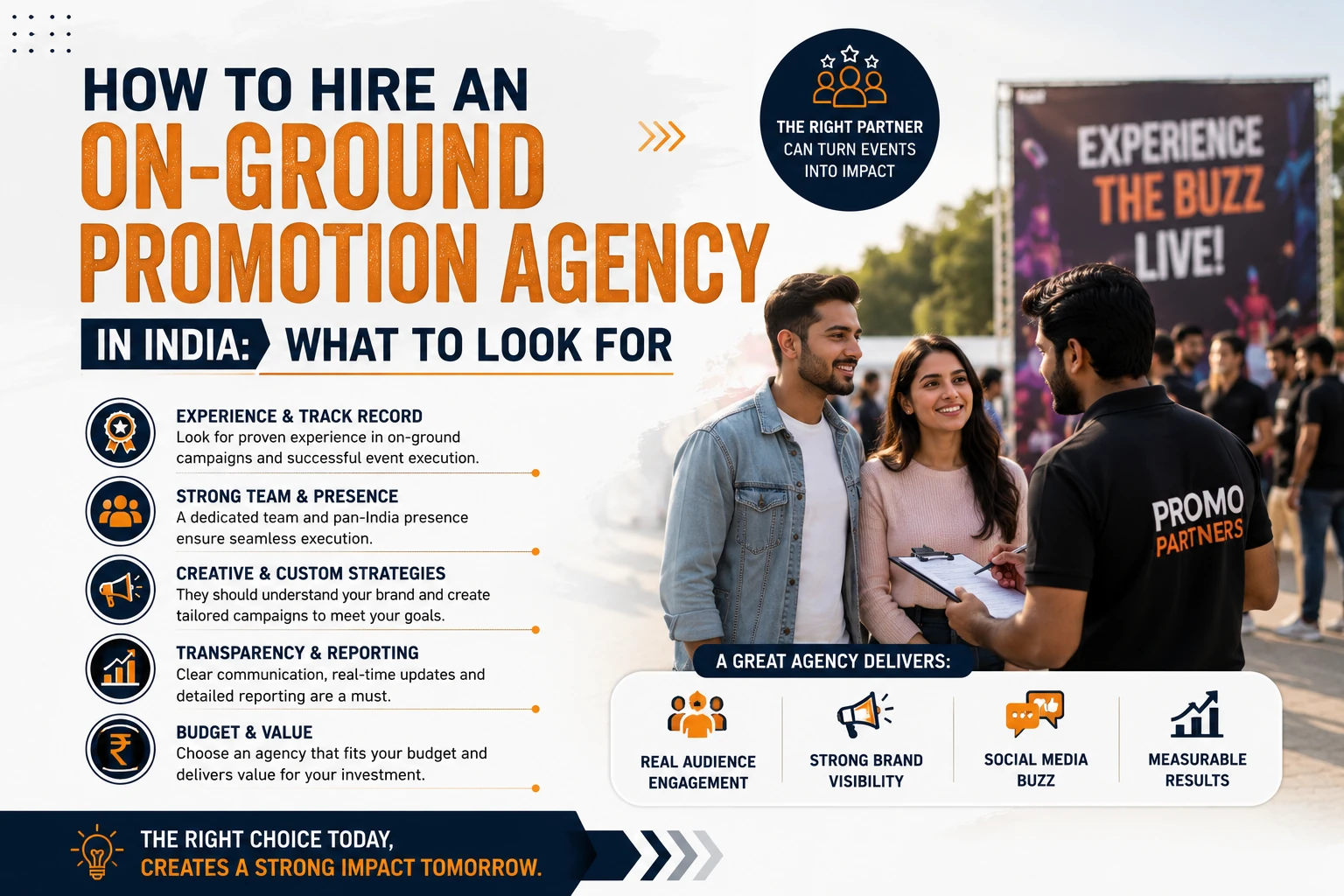
Look past the highlight reel and ask specifically about campaigns in your category and city. An agency with a strong FMCG sampling portfolio isn't automatically the right fit for a real estate launch event or an entertainment premiere — the permissions, audience behavior, and execution style differ meaningfully. Ask for client references you can actually call, not just a logo wall.
2. Local ground infrastructure — not just a head office
This is the single most common gap between agencies that look similar on a pitch deck. A genuinely capable agency has its own field teams or long-established vendor relationships across the specific cities and even specific neighborhoods your campaign needs — not just a presence in the two or three metros most agencies default to. For campaigns beyond major metros, ask directly: does the agency have real infrastructure in tier-2 and tier-3 locations, or would they be subcontracting a local partner they've never worked with before?
3. In-house versus fully outsourced execution
Many agencies keep fabrication, branding production, promoter staffing, and logistics in-house; others broker out most of the actual execution to third parties. In-house capability generally means faster turnaround, more consistent quality, and fewer costly miscommunications between layers of subcontracting — worth asking directly which parts of execution the agency actually owns versus outsources.
4. Permissions and compliance handling
On-ground activations in India — especially in malls, public spaces, campuses, and residential societies — require navigating local permissions, security clearances, and sometimes municipal or police approvals. An agency with established relationships and experience handling this specific bureaucracy will move faster and hit fewer last-minute blockers than one learning the process for the first time on your campaign's clock.
5. Promoter and staff quality
Trained promoters, anchors, and brand representatives are the actual human face of the brand during an activation — their ability to engage an audience, follow a brief, and represent the brand appropriately matters as much as the creative concept behind the campaign. Ask how the agency recruits, trains, and briefs its on-ground staff, and whether they can provide staff who speak the local language and understand regional cultural context, which matters enormously outside major English-fluent metros.
6. Measurement and reporting capability
The best agencies define success metrics before the campaign launches, not after — footfall, leads generated, samples distributed, conversion rate, and social reach should all be part of a pre-agreed reporting framework. Ask to see a sample campaign report from a past client before signing, so you know exactly what kind of data you'll actually get back.
7. Digital amplification capability
An on-ground activation with no plan to extend its reach online leaves significant value on the table. Ask whether the agency can integrate creator briefings, hashtag strategy, and content capture into the activation itself — or whether that's a separate capability you'll need to source elsewhere and coordinate independently.
Questions to Ask in the First Meeting
- Can you share three campaigns you've run in this exact category, and can I speak to those clients directly?
- What's your actual ground infrastructure in [specific cities], and is any part of this campaign subcontracted to a partner I haven't vetted?
- Which parts of execution — fabrication, staffing, logistics — does your team handle in-house?
- How do you handle permissions and approvals in [specific venue type], and what's your track record with delays or rejections?
- What does your standard post-campaign report actually include, and can I see a sample?
- Can you integrate influencer or content capture into this activation, or is that outside your scope?
- What happens if a promoter doesn't show up, a venue falls through, or weather disrupts an outdoor activation — what's the actual contingency plan, not just the assurance that one exists?
Red Flags to Watch For
- Vague answers about ground infrastructure. If an agency can't clearly explain their actual presence in your target cities versus who they'd be subcontracting, that's a real risk to campaign quality and timeline.
- No specific measurement framework offered upfront. An agency that can't describe what data you'll receive after the campaign likely isn't tracking it rigorously during execution either.
- Reluctance to share client references. A genuinely strong agency will happily connect you with past clients; hesitation here is a meaningful signal.
- Pricing that's dramatically lower than every other quote. Unusually low bids in on-ground execution often mean under-staffing, cut corners on permissions, or lower-quality materials — all of which show up as problems on activation day, not before.
- No clear answer on contingency planning. Weather, no-show staff, and last-minute permission issues are common enough in on-ground execution that any experienced agency should have a real, specific answer ready.
A Practical Evaluation Framework
When comparing multiple agency proposals side by side, score each on the same criteria rather than judging pitches individually:
- Category and city-specific experience — do they have real, verifiable work in your exact space?
- In-house execution depth — how much of the work do they actually own versus subcontract?
- Local infrastructure fit — does their footprint genuinely match your target geography, including any tier-2/3 requirements?
- Measurement rigor — is there a defined, pre-agreed reporting framework, or a vague promise of "we'll track it"?
- Digital integration — can they build amplification into the plan, or does that require a separate vendor?
- Cost versus scope clarity — is the quote itemized clearly enough to compare fairly against competitors, or is it a single bundled number that's hard to evaluate?
The right agency won't necessarily be the cheapest or the biggest name — it'll be the one whose actual infrastructure, category experience, and measurement discipline match what your specific campaign needs.
FAQs on Hiring an On-Ground Promotion Agency in India
How much does it cost to hire an on-ground promotion agency in India? Costs vary significantly by format, scale, and city — a single-day mall sampling activation costs a fraction of a multi-city roadshow or a large-scale immersive installation. Get itemized quotes from multiple agencies rather than comparing single bundled numbers, since scope often varies as much as price.
Should a brand hire a national agency or a local city-specific agency? It depends on the campaign's geographic scope. A single-city activation may be better served by a strong local agency with deep infrastructure in that specific market, while multi-city campaigns generally benefit from an agency with genuine pan-India execution capability rather than one subcontracting unfamiliar local partners in each city.
What's the biggest mistake brands make when hiring an on-ground agency? Choosing based on portfolio polish or price alone, without verifying the agency's actual local infrastructure, in-house execution capability, and measurement framework — gaps that only become obvious once the campaign is already underway.
Can an on-ground promotion agency also handle digital amplification? Some agencies build content capture, creator briefing, and hashtag strategy directly into their activation execution; others focus purely on physical logistics and expect a separate digital or influencer marketing partner. Clarify this scope explicitly before signing.