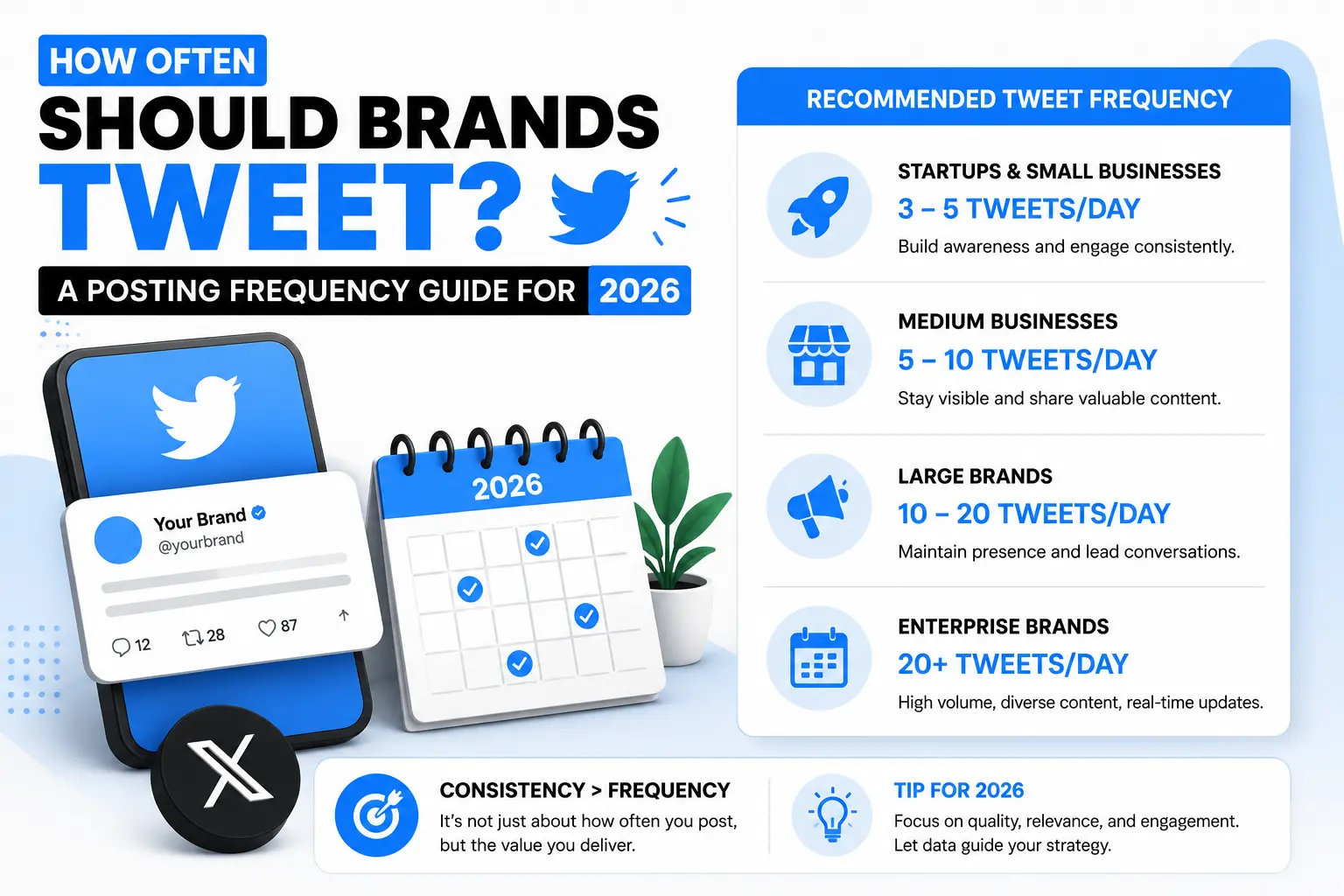
How Often Should Brands Tweet? A Posting Frequency Guide for 2026
There's no single magic number for how often a brand should post on X — anyone who gives you one flat answer is skipping the parts that actually matter: your account size, your industry, your team's bandwidth, and how much of your "posting" is original content versus replies. But there is a well-supported range, and more importantly, a set of principles that explain why that range exists — which is far more useful than a number alone.
Here's what the current data actually supports, and how to build a posting cadence that fits your brand instead of copying someone else's schedule.
The Short Answer
For most brand accounts, 3 to 5 original posts per day is the range that shows up consistently across current benchmarks — enough to stay visible in X's fast-moving, recency-driven feed without overwhelming followers or diluting quality. Below that, brands tend to fade out of the algorithm between posts; above roughly 5–7 high-effort posts a day, returns tend to plateau or even reverse as content quality drops and audience fatigue sets in.
That said, "3 to 5" is a starting point, not a rule. The right number depends heavily on account size, industry, and — critically — how much of your daily activity is original tweets versus replies.
Why Posting Frequency Matters More on X Than Almost Any Other Platform
Unlike Instagram or a blog post, a tweet has a brutally short shelf life — most of its engagement happens within the first 15–20 minutes after posting, and X's algorithm weights early engagement velocity (fast likes, reposts, and replies) heavily when deciding how far to push a post. That combination means frequency isn't just about "staying top of mind" the way it is on other platforms — it's about giving yourself enough at-bats for the algorithm to actually notice you, since any single post has a narrow, fast-closing window to prove itself.
This is also why X rewards a different kind of consistency than Instagram or LinkedIn. A brand that posts once a day at the theoretically perfect time will generally underperform one that posts several times a week at good — not perfect — times, because more attempts simply means more chances to catch a wave of early engagement.
Frequency by Account Size
Posting frequency isn't one-size-fits-all — what works for a media brand with a dedicated social team will bury a small business account in noise, and what works for a small account won't be enough for a large one.
- New or small accounts (under 1,000–5,000 followers): Lean toward the higher end of the range — 3 to 5 original tweets daily — because small accounts need volume to generate enough total impressions to gain traction. Consistency matters more than perfection at this stage.
- Growing mid-size accounts: 2 to 4 high-quality original tweets per day tends to be the sustainable sweet spot, paired with active replies in relevant conversations to extend reach beyond your own follower base.
- Large accounts with dedicated social teams: Can often sustain 5–10 posts daily without hurting engagement, provided quality holds — this is common among tech and media brands with the resources to maintain that pace without slipping into filler content.
- News, media, and real-time-relevant brands: Can reasonably post 10–15+ times daily given the time-sensitive nature of the content itself — a fundamentally different use case than most product or service brands.
The Variable Everyone Underrates: Replies
Original tweet count gets all the attention, but reply volume is arguably just as important to X growth — and it's the piece most brands skip. A common baseline for accounts under 10,000 followers is 3 to 5 original tweets per day plus 15 to 30 replies per day in relevant conversations. Replies put your account in front of audiences you don't already have, in a way original posts alone can't.
Practical takeaway: if you only have bandwidth for one improvement to your X strategy, adding consistent, genuinely useful replies to relevant conversations is often a better use of time than squeezing out one more original post per day.
Quality Still Beats Volume — But Only Above a Certain Floor
It's tempting to read "more posts perform better" as a mandate to post constantly. The data doesn't actually support that. Accounts posting in the range of roughly one to five times daily tend to show stronger growth on average than accounts posting either far less or far more than that — the benefit of frequency plateaus, and can even reverse, once volume comes at the cost of quality.
In other words: there's a real floor below which infrequent posting genuinely hurts visibility, but past a certain point, more tweets stop helping and start diluting your feed with lower-effort content that trains your own followers to pay less attention.
When to Post: Timing Still Matters
Frequency and timing work together, not separately. Current benchmarks consistently point to weekday afternoons — roughly midday through early evening, especially Tuesday through Thursday — as the strongest windows for brand engagement on X, with Saturdays generally the weakest day to post. Morning windows, particularly Monday and Tuesday around 9–10 a.m. local time, also perform well as users check feeds before starting their workday.
Time zones matter more than physical brand location — X's algorithm prioritizes real-time engagement, so posts should be scheduled around when your actual target audience is active, not your headquarters' local time.
A Sample Weekly Framework by Content Type
Not every post needs to be a fast, reactive take. A useful way to structure a week:
- Daily, high-frequency: Quick thoughts, trend reactions, and conversation replies — the bulk of your 3–5 daily posts.
- 1–2 times per week: A short thread or graphic breaking down a takeaway, tip, or campaign result in more depth.
- 1–2 times per month: A poll or open-ended question post specifically designed to invite replies and turn followers into participants.
This mix keeps the account feeling alive daily while reserving higher-effort formats for moments that actually warrant them.
Common Posting Frequency Mistakes
- Treating post count as the only lever. A high volume of low-effort posts can actively hurt growth once it crosses the point where quality visibly drops.
- Ignoring replies entirely. Original posts alone cap your reach at your existing follower base; replies are how most accounts actually grow beyond it.
- Posting on a fixed schedule regardless of what's happening. X rewards real-time relevance — a brand that only posts pre-scheduled content misses the trend-jacking and conversation-joining opportunities that drive outsized engagement.
- Copying a large account's frequency at a small-account stage. A media brand's 10–15 posts a day isn't a benchmark for a small business account — match your cadence to your actual size and resources, not an aspirational one.
FAQs on Brand Posting Frequency on X
Is there one correct number of times to tweet per day?
No single number applies to every brand — but 3 to 5 original posts per day is a well-supported starting range for most business accounts, adjusted up or down based on account size and industry.
Does posting too often hurt engagement?
Yes, past a certain point. Once volume comes at the cost of quality — filler content, repetitive angles, low effort — growth tends to plateau or decline, even though moderate increases in frequency generally help.
Are replies as important as original tweets?
For most growing accounts, yes — arguably more so. Replies put a brand in front of audiences beyond its existing followers, and a baseline of 15–30 relevant replies per day alongside original posting is a common recommendation for accounts still building an audience.
What's the best time of day for brands to post on X?
Current data points to weekday afternoons, particularly Tuesday through Thursday from around midday to early evening, as consistently strong engagement windows, with Saturday generally the weakest day.