How Duolingo, Zomato & Swiggy Nail Meme Marketing (India Case Studies)
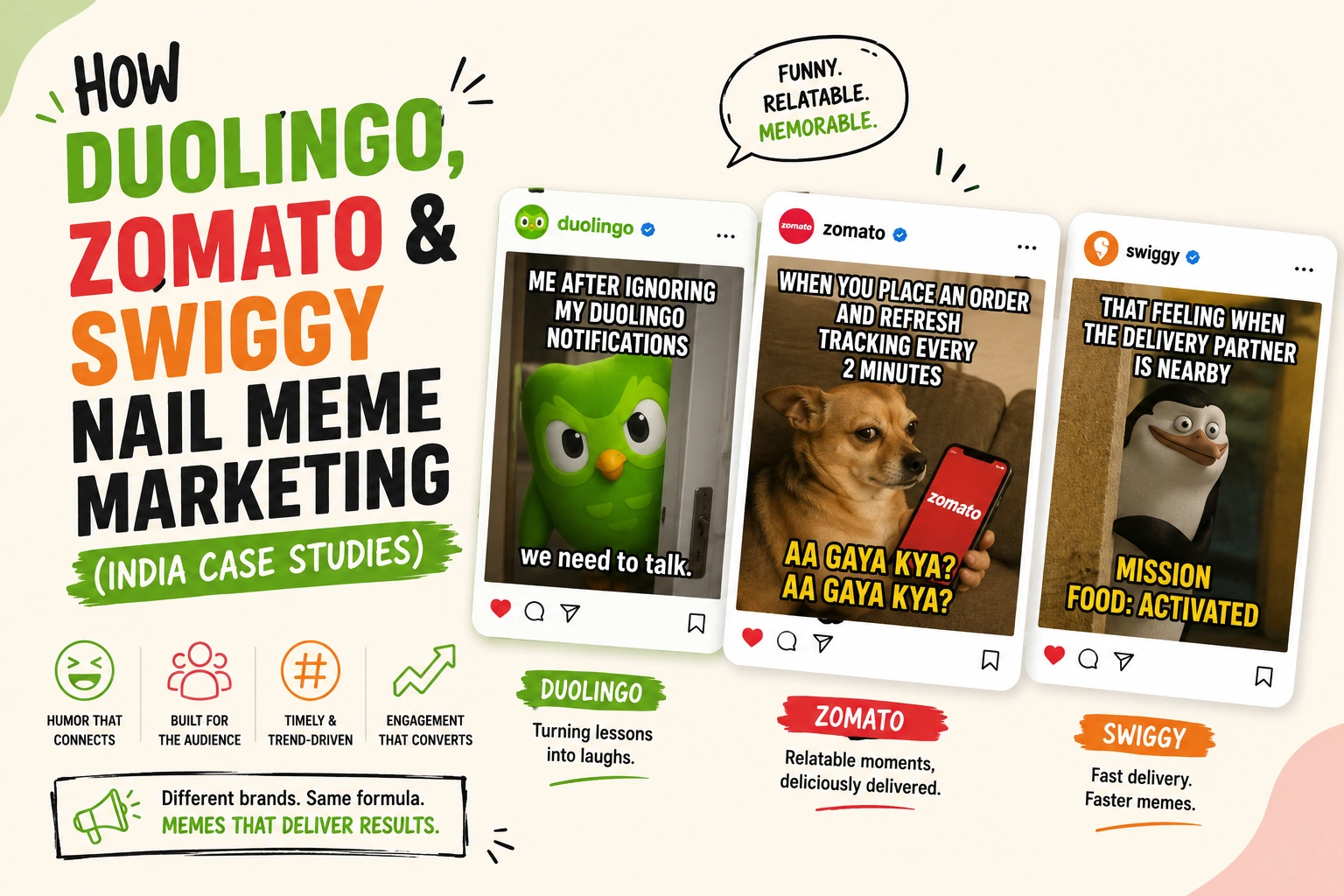
Three brands come up in almost every conversation about meme marketing in India: Duolingo, Zomato, and Swiggy. None of them sell an inherently "fun" product — a language app, a food delivery aggregator, and its biggest rival. Yet all three have built some of the most-followed, most-quoted brand voices on Indian social media, almost entirely through humor and cultural timing.
What's useful about these three isn't just that they're funny — it's that their approaches are genuinely different from each other. Here's what each brand actually does, and what any marketing team can steal from it.
Duolingo: Turning a Meme About the Brand Into the Brand
Duolingo's meme strategy didn't start as a plan — it started as damage control that worked too well.
Internet users began joking that Duo, the app's green owl mascot, was unsettlingly intense about reminding people to finish their lessons — exaggerating him into a stalker-ish figure who'd track users down for skipping a streak. Instead of ignoring or suppressing the joke, Duolingo's marketing team leaned all the way in, turning the mascot into a self-aware, slightly unhinged character across social media. The result: a meme about the brand became the brand's actual voice.
In India specifically, that same instinct shows up as speed and reactiveness rather than a fixed content calendar. Duolingo's India marketing team has described their approach as creating original content around trending topics and moments — such as reacting to a Calvin Klein campaign or Dua Lipa's visit to the country — alongside ongoing meme marketing and conversation-jacking. When Indian business figure Anand Mahindra tweeted about the brand, Duolingo's team treated it as a cue to jump into the conversation in real time, describing this reactive approach as central to staying relevant and building engagement.
What to steal: Duolingo's real skill isn't the jokes themselves — it's the decision to let internet culture write the brand voice, rather than fighting to control it. If your audience is already making a joke about your brand, that joke is market research. Ignoring it is a missed opportunity; owning it, publicly and without defensiveness, is often the fastest way to make a brand feel human.
Zomato: Weaponizing Real-Time Wit
Zomato's approach is closer to a live newsroom than a content calendar. The brand has built its entire social identity around reacting to whatever India is already talking about — cricket, budget day, a trending movie, a viral phrase — within hours, not days.
One widely cited example: when a customer's order note simply read "1 fish fry," Zomato's support team replied with a pun tying it to a trending "fish splash" joke — a screenshot of the exchange that racked up over 300,000 views on Twitter once shared. Zomato didn't plan a meme campaign here; a routine customer interaction became one because the brand's tone was already loose enough to allow it.
The same pattern shows up structurally. Zomato uses Twitter for witty, real-time banter and topical humor, LinkedIn for a more professional-but-still-fun brand voice, and YouTube Shorts for relatable, skit-style foodie content — three different registers of the same underlying personality. The brand has repeatedly hijacked major trending moments — from film releases to IPL season to Union Budget day — in real time, a newsroom-style agility that's become a recurring reference point in Indian digital marketing. Much of it, notably, runs on simple, low-cost execution — a Canva graphic and sharp copy — rather than any production budget, which is exactly what makes the high engagement it drives stand out.
Zomato has also turned brand rivalry into content. When Swiggy announced its IPO, Zomato posted a cheeky, casual congratulatory message that leaned into their public rivalry rather than avoiding it, and the post went viral — pulling in reactions from other brands, influencers, and fans who piled onto the exchange.
What to steal: Zomato's advantage isn't a bigger team — it's a shorter approval chain for time-sensitive content, and a willingness to let a support ticket or a rival's milestone become a public moment. If your meme content is still waiting on multi-step sign-off by the time the trend has moved on, you've already lost the speed advantage that makes this format work.
Swiggy: Structured Formats Over One-Off Jokes
Where Zomato leans on speed and improvisation, Swiggy's meme marketing has leaned more heavily on repeatable, structured formats — content built to be a recognizable series rather than a single viral moment.
One example is a meme series featuring a Swiggy delivery rider knocking on the doors of different teams, with the joke tied to those teams losing — a format that gained popularity quickly and became one of Swiggy's more successful campaigns. Swiggy has also run "Expectation vs. Reality"-style meme formats around everyday food habits, and interactive campaigns like "Voice of Hunger," where users sent in voice notes shaped like specific food items on Instagram — a format that drew thousands of responses and made the brand a trending topic in its own right.
Academic analysis of both brands' Twitter activity between 2020 and 2022 found a similar pattern for Swiggy — tapping into ongoing Twitter trends much like Zomato, including lockdown-era content and jokes around everyday Indian food combinations like dal-chawal, with researchers noting Swiggy's memes achieved a marginally higher reach in that comparison.
What to steal: Not every meme needs to be a one-off. A recognizable format — a recurring character, a consistent comparison structure, a signature response style — builds audience anticipation the way a running gag does. It also makes production faster over time, since the team is refining a format instead of reinventing the wheel for every post.
What Duolingo, Zomato, and Swiggy Actually Have in Common
Strip away the individual tactics, and three shared principles show up across all three brands:
- A consistent, permission-giving brand voice. None of these brands treat memes as a one-off campaign — humor is the default tone, which means the team doesn't need special approval every time they want to be funny. That consistency is what makes the fast reaction times possible.
- Speed beats production value. None of the examples above required a shoot, a studio, or a big budget. A tweet, a support-chat reply, and a Canva graphic all outperformed polished ad creative because they landed inside the cultural moment, not after it.
- Community participation is treated as the win condition. In every case, the brand's post wasn't the end of the content — it was the start of a thread of replies, remixes, and rival brands jumping in. The goal isn't just impressions; it's getting the audience to keep the joke going.
How to Apply This to Your Own Brand
- Loosen the approval chain for reactive content. Keep trend-jacking and meme replies on a separate, faster review lane than your planned content calendar — even a single same-day check is enough to catch real risk without killing the speed advantage.
- Watch your own mentions and support tickets, not just trends. Some of Zomato's best-performing content came from a support reply, not a planned post. Your customer service inbox may already contain your next meme.
- Build one repeatable format before chasing one-off virality. A Swiggy-style recurring series is easier to plan, brief, and measure than trying to manufacture a single viral moment from scratch.
- Decide your brand's tolerance for risk in advance. Duolingo and Zomato both operate with a high tolerance for cheeky, even slightly chaotic humor. If your brand or category can't support that tone, don't try to force it — a warmer, safer version of the same reactive-timing principle still works.
FAQs on Meme Marketing in India
Why do Zomato and Swiggy specifically do well with meme marketing?
Both brands sell a daily, high-frequency product — food — which gives them constant, low-stakes reasons to show up in casual conversation. Combined with fast internal approval for social content, that lets them react to trends within hours.
Is Duolingo's meme strategy replicable for smaller brands?
The core mechanism is replicable even without Duolingo's scale: treat jokes the internet already makes about your brand as material to lean into, rather than something to suppress or ignore.
Do these brands only use humor, or is there strategy behind it?
There's clear strategy underneath the jokes — consistent brand voice, platform-specific content formats, and fast-turnaround production. The humor is the surface layer; the operational speed underneath it is the real differentiator.
What's the biggest risk of copying this style of meme marketing?
The most common failure mode is forcing a joke or format that doesn't fit the brand's actual audience or category — see our breakdown of real brand meme fails for what that looks like in practice.